Why ECE 22.06 is Much Harder to Pass Than ECE 22.05

Why ECE 22.06 is Much Harder to Pass Than ECE 22.05
For decades, the ECE 22.05 certification was the global "gold standard" for motorcycle helmet safety. If you saw that sticker, you knew you were protected. However, as our understanding of head trauma and crash dynamics has evolved, the bar has been raised.
The introduction of ECE 22.06 isn't just a minor tweak—it is a rigorous overhaul that has left many manufacturers scrambling to redesign their products. Here is why passing this new test is a significantly greater challenge.
1. More Impact Points, Less Room for Error
Under the old 22.05 regime, helmets were tested at five specific points. This allowed some manufacturers to "cheat" the system by reinforcing only those five spots while leaving other areas of the shell thinner to save weight.
The 12-Point Expansion
ECE 22.06 has effectively killed the "reinforced spot" strategy. Engineers must now account for 12 additional impact points.
-
Uniform Protection: The helmet must now prove it can absorb energy across the entire surface area.
-
Randomized Testing: Test technicians can choose extra points to hit, meaning there are no "weak spots" allowed in a certified 22.06 helmet.
2. Dealing with Rotational Forces
The most dangerous force in a motorcycle accident often isn't the direct hit, but the rotational torque that occurs when the helmet catches on the pavement during a slide. This twisting motion causes the brain to rotate inside the skull, leading to Traumatic Brain Injuries (TBI).
The Angled Anvil Test
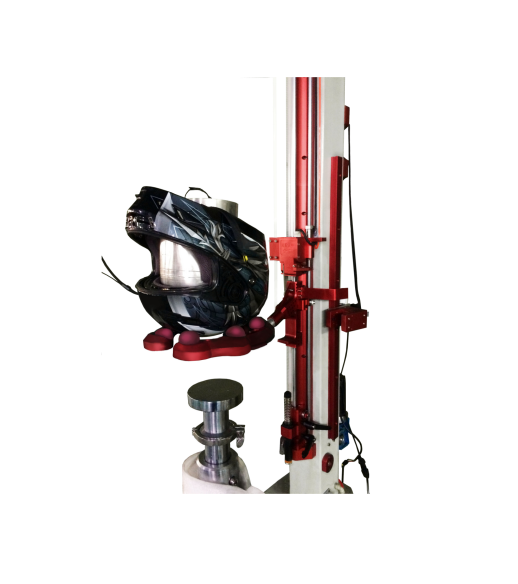
While ECE 22.05 only tested for linear (straight-on) impacts, ECE 22.06 introduces the oblique impact test.
-
The Process: A helmet is dropped onto an angled anvil at a specific speed.
-
The Measurement: Sensors inside the headform measure the rotational acceleration.
-
The Solution: To pass, helmets often require specialized technologies like MIPS (Multi-directional Impact Protection System) or sophisticated low-friction EPS liners to allow the helmet to "slip" slightly during a crash.
3. High and Low Speed: The Two-Front War
A common misconception is that a "harder" helmet is always safer. In reality, a helmet that is too stiff won't crush during a low-speed fall, sending all the shock directly to the rider's brain.
The Variable Velocity Challenge
ECE 22.06 requires the helmet to perform perfectly at three different impact speeds:
-
Low Speed: Ensures the shell and liner are soft enough to cushion minor falls.
-
Medium Speed: The standard "average" crash scenario.
-
High Speed: Tests the ultimate structural integrity of the outer shell.
Designing a liner that is "soft" enough for low speeds but "strong" enough for high-speed impacts is an engineering nightmare that requires multi-density foam layers.
4. Accessory Integration and Strict Visor Standards
In the past, riders would bolt cameras and Bluetooth units to their helmets without knowing if it compromised safety. ECE 22.06 changes that.
Testing with "Add-ons"
If a manufacturer sells a helmet with an integrated intercom or a sun peak, the helmet must be tested with those accessories attached. If the accessory causes the helmet to catch or fail the rotation test, the helmet fails the entire certification.
Ballistic Visor Testing
The visor requirements have also become much tougher. A steel ball is fired at the visor at 60 meters per second.
-
The visor must not shatter.
-
It must not detach from the helmet.
-
It must not allow the ball to touch the "eye" of the test headform.
5. Why This Matters for Your Next Ride
The primary purpose of ECE 22.06 is to bridge the gap between "laboratory safety" and "real-world survival." While these helmets might be slightly larger or more expensive due to the advanced materials required, the level of protection is incomparable.
Summary of the Difficulty Spike:
-
Linear Impacts: Tested at more locations.
-
Rotational Impacts: A brand-new requirement that 22.05 didn't have.
-
Visor Strength: High-speed particle resistance.
-
Accessories: Must be safety-verified.
Conclusion: A New Era of Safety
Passing ECE 22.06 is much harder because the world is a complex place, and crashes are rarely simple. By forcing manufacturers to account for oblique angles, multiple speeds, and integrated tech, the new standard ensures that your gear is as smart as it is tough.
Navigating ECE R22.06: A Strategic Roadmap for Helmet Manufacturers to Secure EU Market Access
What is ECE 22.06? Everything You Need to Know About the New Helmet Standard
Related Article