Why Bicycle Helmet Compliance Testing Is Important

Why Bicycle Helmet Compliance Testing Is Important

This is why bicycle helmet compliance testing is an essential part of helmet manufacturing and quality control.
Why Must Bicycle Helmets Be Tested?
During a bicycle accident, the helmet may experience a strong impact against the ground or another hard surface. The shell and energy-absorbing liner need to reduce the impact force transmitted to the rider's head.
Without laboratory testing, manufacturers cannot reliably determine whether a helmet can provide the required level of protection.
Compliance testing helps manufacturers verify:
-
Impact attenuation performance
-
Shock absorption capability
-
Retention system performance
-
Positional stability
-
Field of vision
-
Product consistency
A compliant helmet is not only important for meeting regulatory requirements but also for protecting the end user and maintaining product quality.
Major Bicycle Helmet Safety Standards
Different markets may require different bicycle helmet standards.
EN 1078:2012+A1:2012 is an important European standard for helmets used by pedal cyclists. It includes requirements for shock absorption, retention systems, field of vision, construction, and other characteristics.
In the United States, bicycle helmets are subject to CPSC 16 CFR Part 1203, which includes requirements for impact attenuation, positional stability, retention strength, and peripheral vision.
ASTM F1447-24 is another important standard covering helmets used in recreational bicycling and roller skating, including specified impact testing requirements.
Manufacturers should select testing equipment according to the applicable standard and target market.
Why Is Impact Testing So Important?
Impact attenuation testing is one of the most important bicycle helmet safety tests.
A helmet may have a high-quality appearance and materials, but these factors alone cannot prove its protective performance.
During an impact test, the helmet is mounted on a specified headform and subjected to a controlled impact. An acceleration sensor records the headform's response.
The test data can then be compared with the requirements of the applicable standard.
This allows manufacturers to determine whether the helmet can effectively absorb impact energy and limit the acceleration transmitted to the head.
Bicycle Helmet Impact Tester
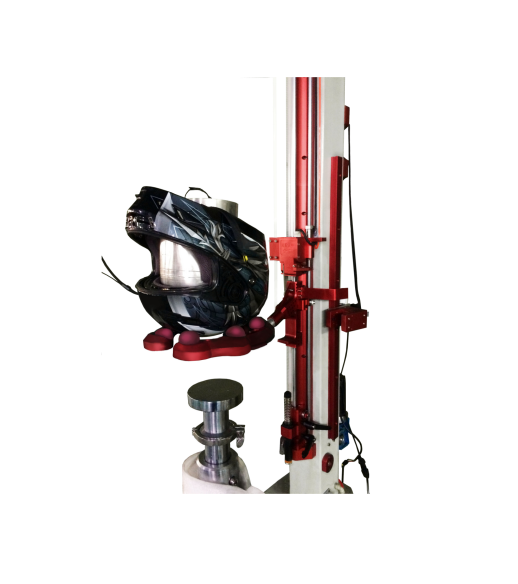
A professional Bicycle Helmet Impact Tester provides controlled and repeatable conditions for evaluating helmet impact performance.
Typical components include:
-
Helmet headform
-
Impact anvil
-
Controlled drop mechanism
-
Acceleration sensor
-
Data acquisition system
-
Test control software
The equipment can be used for product development, internal quality control, and pre-compliance testing.
Manufacturers can test prototype helmets, compare different liner materials, identify design problems, and verify production consistency before submitting products for third-party certification.
Conclusion
Bicycle helmet compliance testing is essential because helmet safety cannot be judged by appearance alone.
Standards such as EN 1078, CPSC 16 CFR Part 1203, and ASTM F1447 provide standardized methods for evaluating helmet performance.
Among these tests, impact attenuation testing is particularly important because it directly evaluates the helmet's ability to manage impact forces.
A reliable Bicycle Helmet Impact Tester helps manufacturers verify helmet performance, improve product design, control quality, and develop safer and compliant bicycle helmets.
If you are looking for bicycle helmet testing equipment or a bicycle helmet impact tester, contact us with your required standard and testing requirements.
EN 1078 Helmet Impact Test: Bicycle Helmet Shock Absorption Testing
Behind the Safety Shield: How a Helmet Impact Tester Ensures EN 1078 Compliance
Related Article