Behind the Safety Shield: How a Helmet Impact Tester Ensures EN 1078 Compliance

Behind the Safety Shield: How a Helmet Impact Tester Ensures EN 1078 Compliance

But how do manufacturers guarantee a helmet is ready for the real world? The answer lies behind the closed doors of compliance laboratories, where the Helmet Impact Tester acts as the ultimate judge of life and death.
Here is an inside look at how this advanced testing equipment puts helmets through their paces to meet EN 1078 certification.
What is the EN 1078 Standard Testing Aiming For?
The EN 1078 standard doesn't just look at whether a helmet survives a crash; it measures how much destructive energy is transferred to the rider’s brain. The evaluation focuses on three strict pillars:
-
Shock Absorption Capacity (The core test)
-
Retention System Strength (Ensuring the helmet stays on during a crash)
-
Field of Vision (Ensuring no blind spots for the rider)
To prove these capabilities, specialized helmet testing machinery is required. Below is the breakdown of the most critical equipment used in the process.
The Spotlight: Core Testing Equipment for EN 1078
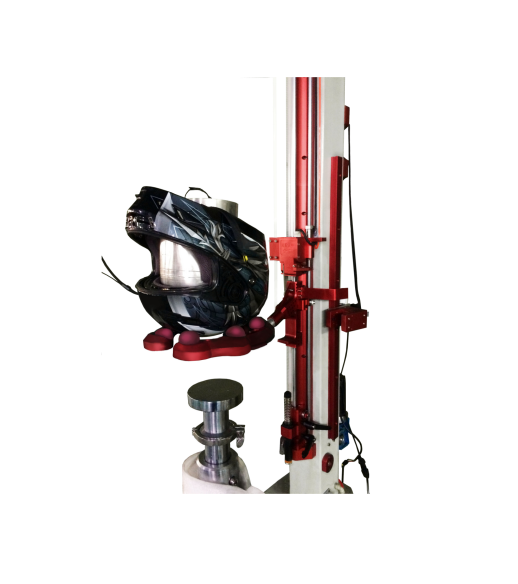
1. The Main Event: Helmet Impact Tester (Drop Testing Machine)
This is the most critical piece of equipment in any helmet laboratory. It simulates the exact scenario of a rider falling and striking their head against a flat road or a sharp curb.
-
How It Works: The machine features a rigid vertical drop tower with low-friction guidance rails. A biofidelic headform (integrated with a high-precision triaxial accelerometer) is placed inside the helmet. The entire assembly is raised to a specific height and released in a controlled free fall.
-
The Anvils (The Impact Surfaces): * Flat Anvil: Simulates a flat concrete road. The helmet strikes it at a velocity of 5.42 m/s (approx. 19.5 km/h).
-
Kerbstone Anvil: Simulates the sharp edge of a pavement or sidewalk. The impact velocity required is 4.57 m/s.
-
-
The Pass/Fail Criteria: The triaxial sensor inside the headform records the peak deceleration. According to EN 1078, the Peak Acceleration must not exceed 250 g. Any helmet that transmits a force higher than 250 g to the headform fails immediately, as such force causes catastrophic brain injury.
2. Environmental Conditioning Chambers (Pre-Treatment Equipment)
Before a helmet ever touches the impact drop tower, it must be conditioned to simulate extreme weather. Materials like EPS (Expanded Polystyrene) behave differently in freezing cold or blistering heat.
-
High/Low Temperature Chambers
-
UV Aging Chambers
3. Helmet Retention System Tester (Roll-off & Strength Test Rig)
A helmet is useless if it flies off your head before you hit the ground. This two-in-one testing machine evaluates the chin strap and buckle integrity.
-
The Roll-Off (Effectiveness) Test: The machine applies a dynamic pulling force via a cable and a dropping weight to the rear or front edge of the helmet, attempting to strip it off the headform. The helmet must remain securely in place.
-
The Dynamic Strength Test: A 10 kg baseline weight is attached to the buckled chin strap, and a 5 kg weight is dropped from a specific height to create a sudden, violent jerk.
-
The Standard: The strap and buckle must not break or tear. The dynamic extension cannot exceed 35 mm, and residual displacement must be under 25 mm to ensure a tight, reliable fit during an accident.
4. Peripheral Vision Tester (Vision Gauge)
Safety gear should never block a rider’s awareness. This optical gauge measures whether the helmet structure obstructs the rider’s sight. It guarantees a clear field of vision.
Conclusion: Why Investing in Premium Testing Equipment Matters
For helmet manufacturers and quality control laboratories, complying with EN 1078 is not just about a certificate—it’s about human lives. Utilizing a state-of-the-art Helmet Impact Tester along with professional retention and conditioning systems ensures that every batch shipped to Europe offers uncompromised safety.
Are you looking to upgrade your laboratory compliance or establish an EN 1078 testing line? Explore our comprehensive range of Helmet Testing Instruments engineered for precision, repeatability, and international standard certification.
Why Bicycle Helmet Compliance Testing Is Important
Helmet Impact Testing Machine
Related Article