Photovoltaic Module Hail Impact Tester: Everything You Need to Know About IEC 61215 Hail Testing
Photovoltaic Module Hail Impact Tester: Everything You Need to Know About IEC 61215 Hail Testing

Even when the front glass appears intact, hail can create invisible micro-cracks inside solar cells. Over time, these defects may reduce power output, accelerate degradation, and shorten the service life of the module. Recent studies also show that larger hailstones can significantly decrease module performance, especially in regions experiencing increasingly severe weather.
For this reason, the Photovoltaic Module Hail Impact Tester has become one of the most important pieces of equipment in PV quality laboratories.
Why Is Hail Testing Important for Solar Panels?
Solar panels are expected to operate outdoors for more than 25 years. During their lifetime, they may experience thousands of weather events.
Hailstones striking a photovoltaic module can cause:
- Front glass cracking
- Solar cell micro-cracks
- Delamination
- Broken interconnections
- Reduced insulation performance
- Power degradation
- Lower long-term reliability
Many of these defects cannot be identified through visual inspection alone. Instead, manufacturers typically perform additional inspections such as:
- Electroluminescence (EL) testing
- Wet leakage current testing
- Power output measurement
- Insulation resistance testing
These evaluations verify whether the module still meets electrical performance requirements after impact.
What Is a Photovoltaic Module Hail Impact Tester?
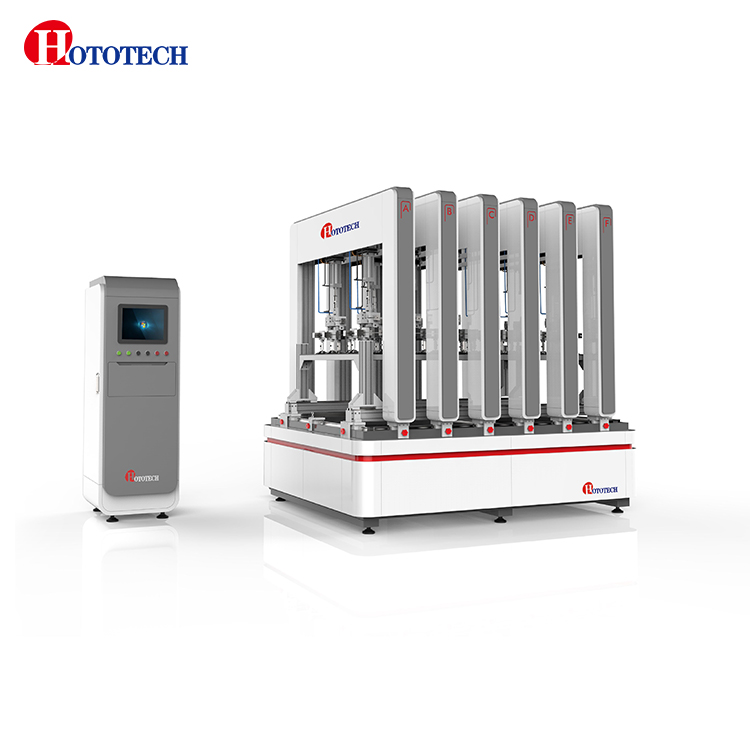
A Photovoltaic Module Hail Impact Tester is a laboratory testing machine designed to launch artificial ice balls at controlled speeds toward solar modules.
The equipment simulates real hailstorms while accurately controlling:
- Ice ball diameter
- Ice ball mass
- Launch velocity
- Impact angle
- Impact position
- Number of impacts
Its purpose is to verify whether photovoltaic modules can survive mechanical impact without unacceptable damage.
Which Standards Require Hail Testing?
The most widely recognized international standard is:
IEC 61215
IEC 61215 specifies environmental qualification tests for crystalline silicon photovoltaic modules.
Under the standard hail test, a PV module must withstand impacts from 25 mm ice balls traveling at approximately 23 m/s at multiple designated locations without unacceptable performance degradation. Optional higher-severity tests also exist using larger ice balls and higher velocities for installations in hail-prone regions.
Additional standards include:
- IEC TS 63397
- IEC 61730
- UL certification requirements (depending on market)
IEC TS 63397 introduces enhanced hail testing sequences intended for modules used in environments with elevated hail risk.
How Does a Solar Panel Hail Test Work?
A typical hail impact test follows several steps:
Step 1: Ice Ball Preparation
Ice balls are manufactured with controlled dimensions and density to ensure repeatable impact energy.
Step 2: Sample Positioning
The photovoltaic module is securely mounted on the testing frame according to IEC requirements.
Step 3: Impact Launch
The launcher accelerates the ice ball to the specified velocity before striking designated locations across the module.
Step 4: Post-Impact Inspection
After testing, engineers inspect the module using:
- EL imaging
- Visual inspection
- Electrical performance measurement
- Wet leakage current testing
- Insulation testing
These inspections determine whether hidden damage has occurred.
What Equipment Is Used in a PV Hail Test Laboratory?
A complete photovoltaic reliability laboratory commonly includes:
- Photovoltaic Module Hail Impact Tester
- Electroluminescence (EL) Tester
- Wet Leakage Current Tester
- Mechanical Load Tester
- UV Preconditioning Chamber
- Damp Heat Chamber
- Thermal Cycling Chamber
- Insulation Resistance Tester
Together, these systems evaluate the mechanical and electrical durability of solar modules throughout their expected service life.
Who Uses a Photovoltaic Module Hail Impact Tester?
Typical users include:
- Solar panel manufacturers
- Third-party certification laboratories
- University research centers
- National testing institutes
- PV component suppliers
- Renewable energy research organizations
These organizations rely on hail testing to support product development, certification, quality control, and reliability verification.
Why Has Hail Testing Become More Important?
Extreme weather events have become more frequent in many parts of the world. Researchers report that hailstorms can exceed the minimum conditions defined by conventional qualification tests, prompting manufacturers to evaluate modules under more severe impact scenarios.
Modern high-efficiency modules often feature:
- Larger wafer sizes
- Thinner cells
- Glass-glass structures
- Higher power densities
While these designs improve energy production, they also make rigorous mechanical impact testing increasingly important during product development.
How to Choose a Photovoltaic Module Hail Impact Tester
When selecting a testing system, manufacturers should consider:
- Compliance with IEC 61215 and IEC TS 63397
- Accurate impact velocity control
- Repeatable ice ball launching
- Adjustable impact positions
- Support for multiple ice ball sizes
- High testing repeatability
- Automated data recording
- Safety protection systems
- Easy maintenance
A reliable hail impact tester should deliver consistent results across repeated tests while minimizing operator intervention.
Conclusion
The Photovoltaic Module Hail Impact Tester is an essential piece of photovoltaic testing equipment for evaluating the mechanical durability of solar panels.
By accurately reproducing hail impacts specified in IEC 61215, manufacturers can identify structural weaknesses before products reach the market, improve module reliability, and provide greater confidence to customers installing solar systems in challenging climates.
As photovoltaic technology continues to evolve, rigorous Solar Panel Hail Testing will remain a critical step in ensuring long-term performance, safety, and durability.
PV Module Hail Impact Testing Machine: Why Is It Essential for Solar Panel Reliability Testing?
How to Operate a Wet Leakage Current Tester: A Practical Guide from the Equipment Manufacturer