Home /News /Safety Protection Testing Machine /How Precision Sensors and 45° Anvils are Redefining Modern Helmet Safety /
How Precision Sensors and 45° Anvils are Redefining Modern Helmet Safety
author: Heather
2026-01-21
How Precision Sensors and 45° Anvils are Redefining Modern Helmet Safety
Helmets stand as the last line of defense for riders, athletes, and industrial workers, but their safety performance is only as reliable as the standards and testing equipment that validate them. In recent years, the introduction of the ECE R22.06 standard has revolutionized helmet safety requirements, while technological breakthroughs in precision sensors and 45° anvils have redefined how we test and enhance helmet protection. This blog explores how these elements converge to set new benchmarks for safety, with a focus on how Hongtu Instruments’ cutting-edge testing equipment is powering compliance with the most rigorous global standards.
The Game-Changing Evolution of ECE R22.06
For over two decades, ECE R22.05 served as the global benchmark for helmet safety, but advancements in crash dynamics and materials science exposed its limitations. The launch of ECE R22.06 marked a paradigm shift, introducing stricter, more realistic testing protocols to address the complex physics of head injuries—especially those caused by rotational forces and multi-angle impacts.
Key Innovations in ECE R22.06
Compared to its predecessor, ECE R22.06 raises the bar in three critical areas, directly driving the demand for advanced testing tools like precision sensors and 45° anvils:
-
Expanded Impact Testing Scope: The number of mandatory impact zones increased from 6 to 18, ensuring comprehensive evaluation of the helmet’s entire surface. This requires testing at diverse angles and velocities, including 6 m/s (low energy), 7.5 m/s (moderate), and 8.2 m/s (high energy) .
-
Rotational Acceleration Assessment: A first for ECE standards, this test targets rotational forces— a leading cause of traumatic brain injuries. It relies on angled impacts and precise data capture to measure a helmet’s ability to mitigate rotational stress .
-
Stricter Retention System & Environmental Testing: ECE R22.06 mandates bi-directional testing of chin straps and low-temperature impact evaluations (-10°C), simulating real-world conditions riders face . Visors also undergo high-speed particle impact tests to ensure facial protection against debris.
45° Anvils: Simulating Real-World Crash Scenarios
At the heart of ECE R22.06’s rotational impact testing lies the 45° anvil—a specialized tool designed to replicate the most common impact angle in cycling, motorcycling, and other helmet-related accidents . This angle is not arbitrary: studies show 45° impacts exert the maximum stress on a helmet’s rotational protection capabilities, making it the gold standard for evaluating real-world crash performance.
Why 45° is Critical for Accurate Testing
Unlike flat or hemispherical anvils that focus on linear impacts, 45° anvils induce both linear and rotational forces, mimicking the twisting motion of the head during a crash. This is critical because the human brain is highly sensitive to rotation around the x (front-to-back) and z (vertical) axes, which 45° impact testing accurately simulates . For ECE R22.06 compliance, helmets must limit angular velocity to ≤10,400 rad/s during 45° impacts at 8 m/s— a requirement that depends on precise anvil design and control .
Precision Sensors: The Backbone of Data-Driven Safety
ECE R22.06’s rigorous requirements demand data capture of unparalleled accuracy. Precision sensors—including accelerometers, gyroscopes, and fiber-optic sensors—enable the real-time measurement of impact forces, acceleration, angular velocity, and displacement, providing actionable insights into helmet performance.
Sensor Specifications for ECE R22.06 Compliance
To meet ECE R22.06’s standards, sensors must adhere to strict performance criteria :
-
High Sampling Rate: ≥1000 Hz to capture millisecond-level dynamic changes during impacts, ensuring no critical data is lost.
-
Accuracy & Durability: Error margins ≤±2% and resistance to extreme forces (≥500g) to maintain reliability during high-impact tests.
-
Compact Design: Miniaturized sensors embed into EN 960 standard headforms without altering the helmet’s fit or impact distribution.
Advanced sensor systems, such as fiber Bragg grating (FBG) sensors, even capture structural deformation “fingerprints” of helmets, enabling machine learning-driven analysis of impact severity and location .
Hongtu Instruments: Powering ECE R22.06 Compliance with Integrated Testing Solutions
To translate ECE R22.06’s requirements into actionable safety outcomes, manufacturers and testing labs rely on equipment that combines precision, versatility, and intelligence. Dongguan Hongtu Instruments Co., Ltd.—a leader in testing equipment研发—has developed integrated solutions that seamlessly integrate 45° anvils, precision sensors, and smart analytics to meet the most stringent global standards.
Core Capabilities of Hongtu’s Helmet Testing Equipment
Hongtu’s equipment is engineered to address ECE R22.06’s full scope of tests, with standout features tailored to 45° impact and precision data capture:
1. Multi-Angle Impact Testing Systems with 45° Anvil Integration
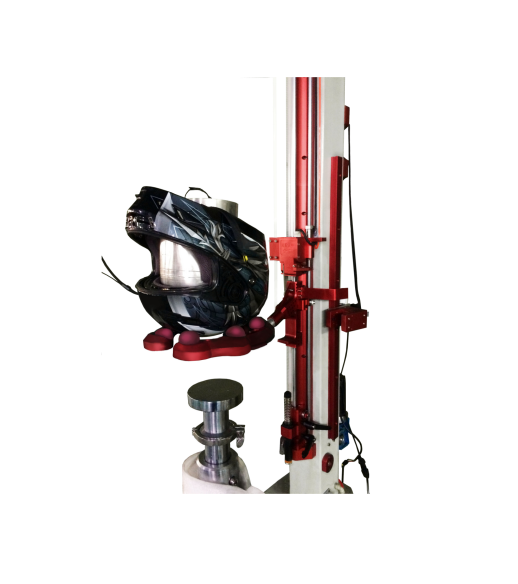
Hongtu’s helmet impact testers support 0°-90° angle adjustment, with a specialized 45° anvil that meets ECE R22.06’s friction coefficient (≤0.78) and impact velocity requirements. The system simulates real-world scenarios by combining 45° impacts with temperature control (-40℃ to 150℃), enabling low-temperature chin strap and shell tests as mandated by the standard . Its servo-controlled design ensures repeatable impacts at speeds up to 10 m/s, covering ECE R22.06’s entire velocity range.
2. High-Precision Sensor Networks for Data Integrity
Integrated with ±0.5% FS precision sensors and optical encoders (0.01mm resolution), Hongtu’s systems capture acceleration, angular velocity, and displacement data in real time. The sensors meet ECE R22.06’s 1000+ Hz sampling rate requirement and transmit data wirelessly to a centralized platform, eliminating signal interference during impacts . AI-powered algorithms automatically generate force-displacement curves and HIC (Head Injury Criterion) values, ensuring compliance with the standard’s limits (e.g., HIC ≤2400 for 7.5 m/s impacts) .
3. Modular Design for Versatile Compliance
Hongtu’s equipment supports quick fixture changes, adapting to motorcycle, sports, industrial, and children’s helmets—all while maintaining ECE R22.06, DOT, and GB standard compatibility. For example, its helmet absorption collision energy tester can switch between flat, hemispherical, and 45° anvils, enabling comprehensive testing of the 18 impact zones required by ECE R22.06 . The system also integrates with third-party analytics platforms, facilitating global certification workflows for labs like SGS and China Quality Certification Center (CQC) .
Real-World Impact: Hongtu’s Role in Industry Advancement
Hongtu’s equipment has become a trusted partner for leading helmet brands and testing institutions worldwide. In a 2025 collaboration with Zhejiang Fangyuan Testing Group—China’s authoritative certification body—Hongtu’s ECE R22.06-compliant systems demonstrated exceptional stability and accuracy during live 45° impact tests, earning praise for their ability to streamline certification processes . By enabling manufacturers to validate rotational protection and multi-angle impact performance, Hongtu’s equipment is accelerating the adoption of safer helmets globally.
The Future of Helmet Safety: Precision, Simulation, and Compliance
As standards like ECE R22.06 continue to evolve, the synergy between 45° anvils, precision sensors, and advanced testing equipment will remain pivotal. Hongtu Instruments’ commitment to innovation—from multi-physics coupling testing to energy-efficient design—ensures that manufacturers can keep pace with regulatory changes while prioritizing user safety. Ultimately, these technologies are not just redefining testing protocols; they are saving lives by turning data into actionable protection.
For helmet brands and testing labs seeking to meet ECE R22.06’s rigorous demands, Hongtu Instruments offers the precision, versatility, and reliability needed to set new safety benchmarks. In a world where every impact matters, the right testing tools make all the difference.
ANSI Z89.1 Standard: A Complete Guide to Industrial Head Protection
Decoding ECE 22.06: Inside the High-Tech Lab Equipment Shaping Helmet Safety
Related Article
The EN 1078 helmet impact test is an important safety test for bicycle helmets, skateboard helmets and roller skate helmets. The standard EN 1078:2012+A1:2012 specifies requirements and test methods for helmet construction, shock absorption, retention systems, field of vision and marking.
EN 1078 Helmet Impact Test: Bicycle Helmet Shock Absorption Testing
Bicycle helmet compliance testing is essential for verifying helmet safety and impact protection. Learn how EN 1078, CPSC 16 CFR Part 1203, and ASTM F1447 evaluate bicycle helmet performance and why a reliable Bicycle Helmet Impact Tester is important for compliance testing.
Why Bicycle Helmet Compliance Testing Is Important
Every time a cyclist or skater puts on a helmet, they are trusting a lightweight shell to save their life. In the global market, especially in Europe, the EN 1078 standard is the definitive legal benchmark for bicycle helmets, skateboards, and roller skate headgear. Here is an inside look at how this advanced testing equipment puts helmets through their paces to meet EN 1078 certification.
Behind the Safety Shield: How a Helmet Impact Tester Ensures EN 1078 Compliance
ECE R22.06 is the latest and most stringent European safety standard for motorcycle and two-wheeler helmets. Reliable helmet test equipment is essential for manufacturers, labs, and certification bodies to verify compliance. HOTOTECH provides the ECE R22.06 helmet testing systems covering impact absorption, penetration resistance, retention system performance, and environmental conditioning.
ECE R22.06 Helmet Test Equipment: Principles & Standards