
The Final Test: How High-Velocity Particle Impact Machines Ensure Eyewear Safety
author: Heather Hu
2025-12-16
The Final Test: How High-Velocity Particle Impact Machines Ensure Eyewear Safety

When you slip on a pair of sunglasses for a day at the beach, put on safety goggles for a home renovation project, or adjust your prescription glasses before a bike ride, you rarely stop to think: Will these lenses protect my eyes when it matters most? Behind every reliable pair of eyewear lies a series of rigorous tests, and none is more critical than the one conducted by high-velocity particle impact machines. These specialized devices are the unsung heroes of ocular safety, ensuring that your eyewear can withstand unexpected projectiles—from flying gravel on the road to rogue sparks in a workshop. Let’s dive into how they work, why they’re essential, and what they mean for the glasses perched on your nose right now.
Why Eyewear Can’t Skip the “Final Test”
The human eye is one of the body’s most delicate organs. A single small particle traveling at high speed—think a grain of sand kicked up by a passing car or a tiny metal shard from a drill—can cause irreversible damage: corneal scratches, retinal tears, or even permanent blindness. That’s why regulatory bodies worldwide (from the FDA in the U.S. to the EU’s CE marking system) mandate strict impact resistance standards for all eyewear, whether it’s fashion sunglasses, children’s glasses, or industrial safety goggles.
This is where high-velocity particle impact machines come in. They replicate the most dangerous real-world scenarios in a controlled lab setting, putting eyewear through the ultimate stress test. Without this step, eyewear might look good or fit well—but it could fail catastrophically when your eyes need it most. The “final test” isn’t just a formality; it’s a non-negotiable barrier between your eyes and harm.
Inside the Machine: How High-Velocity Particle Impact Tests Work
At first glance, a high-velocity particle impact machine might look like a simple piece of lab equipment, but its design is precision-engineered to mimic real-world hazards. Here’s a breakdown of its core components and the step-by-step testing process:
1. The “Projectile”: Replicating Real-World Threats
Tests don’t use random debris—they rely on standardized projectiles that mirror the most common eye hazards. For general eyewear, this often means steel balls (for hard, dense projectiles) or polycarbonate pellets (for lighter, faster-moving particles like dust or gravel). The size and weight of the projectile are calibrated to match specific standards: for example, children’s glasses might be tested with smaller, lighter particles, while industrial goggles face larger, heavier projectiles.
2. The Launch System: Controlling Speed and Force
The machine’s launch system is what gives the test its “high-velocity” name. Most machines use one of two methods: compressed air (for precise, adjustable speeds) or spring-loaded mechanisms (for consistent, repeatable impacts). The goal is to launch the projectile at a speed that mimics real-world scenarios—anywhere from 30 mph (for casual eyewear) to 150 mph (for industrial safety gear). The speed is measured with laser sensors to ensure accuracy; even a 5 mph difference can change the test’s outcome.
3. The Target: Securing the Eyewear
The eyewear is mounted on a specialized headform that replicates the shape and size of a human head (adult or child, depending on the product). This ensures that the impact hits the lens in the same way it would if someone were wearing the glasses. The headform is fixed in place, and the projectile is aimed at the “weakest” points of the lens—usually the center or the edges, where cracks are most likely to start.
4. The Inspection: Pass or Fail?
After the impact, the real work begins: inspection. A pair of eyewear passes the test if two key criteria are met: no lens shattering (even small shards can harm the eye) and no significant deformation (the frame or lens shouldn’t bend so much that it touches the eye). Inspectors use magnifying glasses or microscopes to check for tiny cracks or chips that might be invisible to the naked eye. If the lens holds up, the eyewear moves on to production. If not, the manufacturer has to rethink the lens material or design.
Key Standards: What the Machines Are Testing Against
High-velocity particle impact machines don’t operate in a vacuum—they’re calibrated to meet strict industry standards. These standards vary by use case, but three stand out as the most influential:
ANSI Z87.1 (U.S. Safety Eyewear Standard)
The gold standard for safety goggles and industrial eyewear in the U.S., ANSI Z87.1 requires lenses to withstand impacts from a 1/4-inch steel ball traveling at 150 mph. For “high-impact” rated eyewear, the test is even tougher: a 1/2-inch steel ball at 100 mph.
ISO 12312-1 (Global Sunglasses Standard)
For fashion sunglasses, ISO 12312-1 mandates tests with 6mm steel balls traveling at 45 mph. This standard is designed to protect against common outdoor hazards like flying sand, insects, or small rocks.
EN 166 (EU Personal Eye Protection Standard)
Used across Europe, EN 166 classifies eyewear into “impact categories” (1 to 3), with Category 3 being the highest. Category 3 eyewear must resist a 6mm steel ball at 120 mph—ideal for construction or motorcycling.
Beyond Impact: How the Test Shapes Eyewear Innovation
High-velocity particle impact machines don’t just enforce safety—they drive innovation. When a lens material fails a test, manufacturers go back to the drawing board, developing new composites or coatings to improve impact resistance. For example, polycarbonate (a lightweight, shatterproof plastic) became the go-to material for safety eyewear after it consistently outperformed glass in impact tests. Today, even fashion brands use polycarbonate lenses because of the protection they offer—all thanks to data from impact machines.
The Bottom Line: Your Eyes Deserve the “Final Test”
Next time you buy eyewear, take a moment to check for the safety certifications (ANSI Z87.1, ISO 12312-1, etc.). Behind that small label is a high-velocity particle impact machine that pushed the lenses to their limits—and confirmed they’re strong enough to protect you. These machines don’t just test products; they test our commitment to keeping eyes safe. And in a world full of unexpected hazards, that’s a test we all want to pass.
The Ultimate Guide to EN 166 High-Speed Particle Impact Resistance
Meeting the 45° Challenge: How the ECE R22.06 Oblique Impact Test is Redefining Helmet Safety
Related Article
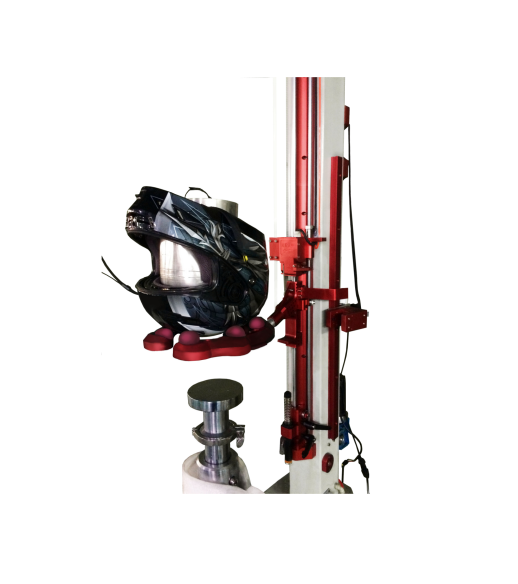
The EN 1078 helmet impact test is an important safety test for bicycle helmets, skateboard helmets and roller skate helmets. The standard EN 1078:2012+A1:2012 specifies requirements and test methods for helmet construction, shock absorption, retention systems, field of vision and marking.
EN 1078 Helmet Impact Test: Bicycle Helmet Shock Absorption Testing

Bicycle helmet compliance testing is essential for verifying helmet safety and impact protection. Learn how EN 1078, CPSC 16 CFR Part 1203, and ASTM F1447 evaluate bicycle helmet performance and why a reliable Bicycle Helmet Impact Tester is important for compliance testing.
Why Bicycle Helmet Compliance Testing Is Important

Every time a cyclist or skater puts on a helmet, they are trusting a lightweight shell to save their life. In the global market, especially in Europe, the EN 1078 standard is the definitive legal benchmark for bicycle helmets, skateboards, and roller skate headgear. Here is an inside look at how this advanced testing equipment puts helmets through their paces to meet EN 1078 certification.
Behind the Safety Shield: How a Helmet Impact Tester Ensures EN 1078 Compliance

ECE R22.06 is the latest and most stringent European safety standard for motorcycle and two-wheeler helmets. Reliable helmet test equipment is essential for manufacturers, labs, and certification bodies to verify compliance. HOTOTECH provides the ECE R22.06 helmet testing systems covering impact absorption, penetration resistance, retention system performance, and environmental conditioning.
ECE R22.06 Helmet Test Equipment: Principles & Standards