
Meeting the 45° Challenge: How the ECE R22.06 Oblique Impact Test is Redefining Helmet Safety
author: Heather Hu
2025-12-11
Meeting the 45° Challenge: How the ECE R22.06 Oblique Impact Test is Redefining Helmet Safety

For motorcyclists, cyclists, and anyone who relies on head protection, a helmet isn’t just gear—it’s a lifeline. But what makes a helmet “safe”? For decades, safety standards have evolved to keep pace with real-world risks, and the latest milestone is impossible to ignore: the ECE R22.06 Oblique Impact Test. This 45° challenge is rewriting the rules of helmet design, pushing manufacturers to prioritize what matters most—reducing traumatic brain injuries (TBIs) in the crashes that happen most often.
The Problem with “Old” Safety Standards: Why Oblique Impact Matters
Traditional helmet tests, like those in the earlier ECE R22.05 standard, focused heavily on linear impacts—think of a helmet hitting a flat surface straight on. While these tests are critical, they miss a key reality: most real-world head impacts aren’t straight. They’re angled, or “oblique,” meaning the helmet slides, twists, and absorbs force in multiple directions at once.
This rotational force is a silent danger. Even if a helmet prevents a skull fracture, the twisting motion can tear brain tissue, cause concussions, or lead to severe TBIs. For years, safety advocates called for standards that address this gap—and ECE R22.06 answered.
What is the ECE R22.06 Oblique Impact Test?
The ECE R22.06 standard, developed by the United Nations Economic Commission for Europe (UNECE), is now the global gold standard for helmet safety. At its core is the 45° oblique impact assessment, a rigorous test that mimics the messy, angled crashes riders face every day.
How the Test Works
Unlike linear tests, which use a flat anvil, the oblique test uses a curved anvil to replicate the uneven surfaces (like pavement, curbs, or vehicle parts) a helmet might hit. Here’s the breakdown:
-
A helmet is fitted to a dummy head with sensors that measure rotational acceleration and linear force.
-
The head-helmet assembly is dropped at a 45° angle onto the curved anvil, simulating a slide-and-impact scenario.
-
To pass, the helmet must keep rotational acceleration below 2750 rad/s²— a threshold proven to significantly reduce TBI risk.
Beyond the Test: How Helmet Design is Evolving
Meeting the 45° challenge isn’t just about passing a test—it’s about reimagining how helmets protect. Manufacturers are now integrating innovative technologies to tackle rotational force, turning “good enough” into “life-saving.”
1. Multi-Layered Impact Absorption
Gone are the days of a single foam layer. Modern ECE R22.06-compliant helmets use dual-density EPS foam—softer layers to absorb initial impact, harder layers to resist penetration—paired with materials like Koroyd (honeycomb-structured polymer) that crumple predictably to dissipate rotational force.
2. Slip Planes: Letting the Helmet Move to Protect the Brain
One of the most game-changing innovations is the slip plane—a low-friction layer between the helmet’s outer shell and inner liner. When the helmet hits an angled surface, the shell slides slightly against the liner, redirecting rotational force away from the brain. It’s like a shock absorber for twist, and it’s now a staple in top-tier helmets.
3. Aerodynamics Meets Safety
Designers aren’t sacrificing comfort for safety, either. ECE R22.06 helmets feature streamlined shapes that reduce wind resistance (critical for motorcyclists) while ensuring the outer shell’s curvature works with the oblique test’s requirements. Ventilation systems are also integrated without compromising impact protection—proving safety and comfort can coexist.
Who Benefits? Every Rider, Every Time
The ECE R22.06 standard isn’t just for professional riders—it’s for the commuter biking to work, the parent teaching their kid to ride, and the motorcyclist taking a weekend trip. Here’s how different users gain from this 45° revolution:
Motorcyclists
In high-speed crashes, rotational force is often the cause of long-term brain damage. ECE R22.06 helmets reduce that risk by up to 40%, according to recent studies—making every ride exponentially safer.
Cyclists (Road and Mountain)
Whether hitting a pothole or wiping out on a trail, cyclists face frequent oblique impacts. Compliant helmets mean fewer concussions and more confidence to push their limits.
Urban Commuters
Busy city streets mean unpredictable crashes (a car door opening, a pedestrian jaywalking). ECE R22.06 helmets offer peace of mind for riders navigating chaotic environments.
How to Choose an ECE R22.06-Compliant Helmet
Not all helmets are created equal—here’s what to look for to ensure you’re getting the best protection:
1. Check the Certification Label
Look for the ECE R22.06 mark (a circle with “E” followed by a country code, e.g., E1 for Germany) inside the helmet. This isn’t a “nice-to-have”—it’s proof the helmet passed the oblique impact test.
2. Prioritize Fit Over Brand
A helmet can have all the latest tech, but if it doesn’t fit snugly (no wobble side-to-side, no gaps at the forehead), it won’t protect you. Always try on a helmet before buying, and adjust the straps to ensure a secure fit.
3. Ask About Rotational Protection
Don’t be afraid to ask the manufacturer or retailer about the helmet’s rotational safety features (slip planes, multi-layer foam, etc.). The best brands will be transparent about how their helmets meet the 45° challenge.
The Future of Helmet Safety: It’s All About the Angle
The ECE R22.06 Oblique Impact Test isn’t just a new standard—it’s a shift in mindset. For too long, helmet safety focused on surviving the crash; now, it’s about thriving after it. By prioritizing rotational force and real-world crash scenarios, this 45° challenge is ensuring that the next time a rider hits the pavement, their helmet does more than just protect their skull—it protects their future.
Whether you’re a seasoned rider or just starting out, choosing an ECE R22.06-compliant helmet isn’t just a purchase—it’s an investment in your safety. After all, the best ride is the one where you come home unharmed.
The Final Test: How High-Velocity Particle Impact Machines Ensure Eyewear Safety
Zhejiang Fangyuan and Zhejiang Entrepreneurs Visited Hubei Hongtu for ECE22.06 Helmet Impact Tester
Related Article
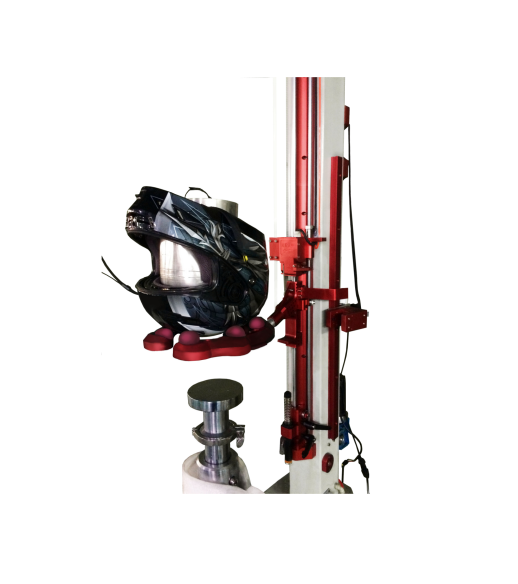
The EN 1078 helmet impact test is an important safety test for bicycle helmets, skateboard helmets and roller skate helmets. The standard EN 1078:2012+A1:2012 specifies requirements and test methods for helmet construction, shock absorption, retention systems, field of vision and marking.
EN 1078 Helmet Impact Test: Bicycle Helmet Shock Absorption Testing

Bicycle helmet compliance testing is essential for verifying helmet safety and impact protection. Learn how EN 1078, CPSC 16 CFR Part 1203, and ASTM F1447 evaluate bicycle helmet performance and why a reliable Bicycle Helmet Impact Tester is important for compliance testing.
Why Bicycle Helmet Compliance Testing Is Important

Every time a cyclist or skater puts on a helmet, they are trusting a lightweight shell to save their life. In the global market, especially in Europe, the EN 1078 standard is the definitive legal benchmark for bicycle helmets, skateboards, and roller skate headgear. Here is an inside look at how this advanced testing equipment puts helmets through their paces to meet EN 1078 certification.
Behind the Safety Shield: How a Helmet Impact Tester Ensures EN 1078 Compliance

ECE R22.06 is the latest and most stringent European safety standard for motorcycle and two-wheeler helmets. Reliable helmet test equipment is essential for manufacturers, labs, and certification bodies to verify compliance. HOTOTECH provides the ECE R22.06 helmet testing systems covering impact absorption, penetration resistance, retention system performance, and environmental conditioning.
ECE R22.06 Helmet Test Equipment: Principles & Standards