
ECE 22.06 vs DOT: Unraveling the Key Differences for Safer Rides
author: Heather Hu
2025-11-10
Introduction

When it comes to motorcycle helmets, safety standards play a crucial role in protecting riders. Two well - known standards in the world of motorcycle safety are ECE 22.06 and DOT. The ECE 22.06 is the latest European economic commission standard for motorcycle helmets, which replaces the previous ECE 22.05. It brings a series of comprehensive and strict test requirements, aiming to enhance the safety performance of helmets. On the other hand, DOT (Department of Transportation) is the safety standard in the United States. It has been around for a while and has its own set of regulations for motorcycle helmets. In this blog, we will compare ECE 22.06 and DOT in detail, exploring their differences in testing methods, safety features, and more. Understanding these differences can help motorcycle riders make more informed decisions when choosing a helmet, ensuring their safety on the road.
What is ECE 22.06?
Origin and Implementation
ECE 22.06 is a safety standard for motorcycle helmets established by the United Nations Economic Commission for Europe (UNECE). The original Regulation No. 22 was implemented in 1972, and the ECE 22.05 standard came into effect in 2000. After being in the market for 20 years, ECE 22.06 began to take effect. It will officially come into force in 2024, replacing the old - version ECE 22.05. This new standard is one of the most extensive helmet safety certifications. It is not only widely used in Europe but also recognized in other countries like Australia. Although ECE 22.05 - certified helmets are still on the market and retailers can sell them for now, they are expected to be gradually replaced by ECE 22.06 - certified products.
Key Testing Requirements
- Helmet Structure
-
- ECE 22.06 tests the basic structure of motorcycle helmets, which includes a sturdy outer shell, an internal impact - absorbing layer, and a comfortable liner. For modular helmets with a deployable chin bar, ECE conducts strict tests to approve the multi - part structure of this type of helmet. There are two types of certifications, P and J. A P - certified helmet is in the closed state, and a J - certified helmet is in the open state. For both certifications, the chin bar must remain in place in both configurations to pass the certification. If the helmet does not meet the requirements, the chin bar will be marked as non - protective. According to the new regulations, modular helmets are only legal for riding as full - face helmets.
- Helmet Shell
-
- The helmet shell and the impact - absorbing layer must be able to resist cold, high temperatures, ultraviolet radiation, humidity, and moisture, and should not degrade over time. The head coverage area and design of the helmet will also be examined. According to the appropriate size, the helmet must cover a minimum head area. Shell deformation is a key point of the new ECE standard. In the new test method, two plates with a total pressure of 630 Newtons are applied to the two sides, front, and rear of the helmet respectively. This test will be carried out on the side, front, and rear of the helmet, and a new helmet is used for each test. To pass the test, the helmet should not deform more than 40 millimeters under the maximum pressure and only 15 millimeters under the minimum pressure of 30 Newtons.
- Helmet Design
-
- The vents on the helmet will be tested and reviewed. ECE also requires that the helmet does not cause discomfort to the rider and does not impede the rider's hearing. The regulation means that the helmet must be able to let in a certain amount of noise, otherwise, it cannot pass the test. Reflective stickers can be applied to the helmet or provided with the helmet, as long as specific usage instructions are provided.
-
- For the main face shield, ECE stipulates that the rider's peripheral vision should not be obstructed from any angle. The minimum light - transmittance level of the face shield must be 20% for colored face shields. Any face shield with a light - transmittance lower than this standard cannot pass the ECE standard. Therefore, colored face shields also need to be tested to ensure that turn signals, brake lights, or other important road lights can still be seen through the face shield. Scratch resistance, as well as distortion, refraction, and anti - fog performance of the face shield, are also tested, especially for helmets that the manufacturer claims to have these functions. During the test, the face shield will face a steel ball shot at a speed of 180 miles per hour.
-
- The visor will also be tested by ECE to ensure that it does not affect the natural movement path of the main face shield and must be independent of the main shield of the helmet. The deployment process of the visor will also be reviewed and must be simple and easy to operate.
- Strap and Retention System
-
- The strap of the helmet should be neither too thin nor too thick and must be permanently fixed to the helmet. The retention system will be tested according to its ease of use, resistance to deformation and stretching, and durability. ECE requires that the strap and retention system must be able to withstand at least 3000 Newtons of pressure without breaking. To test this, a 10 - kilogram (22 - pound) weight is dropped from a height of 0.75 meters to check for damage and deformation. After the test, the hardware must be able to open and close normally. Modular helmets have to undergo additional tests and must pass the tests in both the open and closed states.
- Impact Absorption Layer and Impact Test
-
- The impact - absorption layer will go through several tests. First, there is a degradation test, similar to the test of the helmet shell, but it is positioned according to its proximity to the rider's head. The impact - absorption layer should not degrade prematurely due to sweat, cosmetics, and hair products, and the comfortable liner of the helmet should not cause any skin irritation.
-
- The impact - absorption test covers oblique - impact tests at speeds of 6.0 m/s, 7.5 m/s, 8.2 m/s, and 8.5 m/s (equivalent to 13.4, 16.77, 18.3, and 19 miles per hour). For the standard impact test, the ECE 22.06 certification standard has expanded on the previous series of speeds. In the impact test, various surfaces are used. Whether it is a direct - impact test or an oblique - impact test, it is carried out on an anvil covered with asphalt - like sandpaper. The oblique - impact test is new to the standard, and it tests whether the helmet can protect against rotational acceleration. The value in the test should not exceed the brain injury criterion (BrIC) of 10,400 rad/s².
What is DOT?
Background and History
DOT (Department of Transportation) certification is a safety standard in the United States, and it is a mandatory safety standard for the U.S. market. It is formulated by the U.S. Department of Transportation. The DOT certification, with the standard number FMVSS 218 (Federal Motor Vehicle Safety Standard 218), was initially implemented in 1974. It was then revised in 2013 to better adapt to the modern traffic environment and enhance the safety performance of motorcycle helmets. This standard applies to all motorcycle helmets sold in the United States, aiming to ensure that these helmets can effectively protect the safety of riders' heads during collisions.
Main Testing Items
- Impact Attenuation Test
-
- This test is crucial as it measures the helmet's ability to absorb impact energy. When a motorcycle accident occurs, the helmet needs to effectively reduce the impact force transmitted to the rider's head. In the Impact Attenuation Test, the helmet is installed on an instrumented test head - form. Then, free - fall impact tests are carried out on a fixed hemispherical and a fixed - plane steel anvil. The test requires that the peak acceleration does not exceed 400g, the cumulative duration of acceleration exceeding 200g does not exceed 2.0 milliseconds, and the cumulative duration of acceleration exceeding 150g does not exceed 4.0 milliseconds. By passing this test, the helmet can provide reliable protection for the rider's head in case of a collision, reducing the risk of serious head injuries.
- Field of Vision Requirements
-
- For motorcycle riders, a wide field of vision is essential for safe riding. DOT stipulates that the field of vision starting from the mid - line of the helmet should reach 105°. This ensures that riders can observe the surrounding traffic conditions well. Additionally, any attachments on the helmet surface should not exceed 5mm. This is to prevent these attachments from blocking the rider's line of sight. For example, if there are overly large or protruding decorations on the helmet, they may interfere with the rider's view, increasing the risk of accidents. By setting such requirements, DOT helps riders maintain a good field of vision while wearing a helmet.
- Retention System Test
-
- The retention system of a helmet is what keeps the helmet in place on the rider's head during an accident. In the Retention System Test, the helmet is installed on a stationary test head - form. A static tensile load is applied to the retention system, and the movement of the retention system test device under tension is measured. First, a pre - test load of 50 pounds (22.7 kilograms) is applied for 30 seconds, and the maximum distance from the adjustable part of the retention system test device to the vertex of the helmet is measured. Then, an additional test load of 250 pounds (113.4 kilograms) is applied for 120 seconds, and the distance is measured again. The requirement is that the retention system or its components should not separate during the test, and the movement of the adjustment part should not exceed 1 inch (2.5 centimeters). This test ensures that the helmet will not fall off the rider's head during a collision, maintaining its protective function.
ECE 22.06 vs DOT: The Differences
Stringency of Standards
ECE 22.06 is widely regarded as one of the most stringent helmet safety standards globally. It has a more comprehensive set of requirements compared to DOT. ECE 22.06 tests not only basic safety aspects like impact absorption but also various other factors such as the helmet's ability to resist environmental degradation from cold, high temperatures, ultraviolet radiation, humidity, and moisture. For example, in the impact - absorption test, ECE 22.06 has a wider range of test speeds, including oblique - impact tests at 6.0 m/s, 7.5 m/s, 8.2 m/s, and 8.5 m/s, and the test values should not exceed the brain injury criterion (BrIC) of 10,400 rad/s². DOT, while also aiming to ensure helmet safety, has relatively fewer and less complex test requirements. Its impact attenuation test mainly focuses on peak acceleration, cumulative duration of acceleration exceeding certain thresholds, and the test scenarios are not as diverse as those of ECE 22.06.
Testing Scope
The testing scope of ECE 22.06 is much broader. It delves into the details of helmet design. For modular helmets, it has specific certifications (P and J) for both the closed and open states, and the chin bar must remain in place in both configurations to pass the certification. It also tests aspects like the vents on the helmet, ensuring that they do not cause discomfort to the rider and do not impede the rider's hearing. The face shield's scratch resistance, distortion, refraction, and anti - fog performance are also examined, especially for helmets that claim to have these functions. Additionally, the visor is tested to ensure it does not affect the main face shield and is easy to operate.
In contrast, DOT's testing scope is more limited. Its main testing items are impact attenuation test, field of vision requirements, and retention system test. It does not have as in - depth tests on the design details of the helmet as ECE 22.06. For example, it does not test the helmet's resistance to environmental factors in the same comprehensive way as ECE 22.06, nor does it have such detailed tests on the face shield and visor.
Geographic Application
ECE 22.06 is mainly applied in Europe and is also recognized in many other countries around the world, such as Australia. It has a wide - spread influence in the international market, and manufacturers often need to meet this standard to sell their helmets in these regions.
DOT, on the other hand, is primarily applicable in the United States. Helmets sold in the US market must meet the DOT standard (FMVSS 218). This means that if a manufacturer wants to enter the US motorcycle helmet market, they need to ensure their products comply with DOT requirements, while in other regions, this standard may not be as relevant.
The Significance for Riders
Safety Assurance
For riders, helmets that meet either ECE 22.06 or DOT standards are crucial for their safety. In motorcycle accidents, head injuries are often the most serious and life - threatening. Helmets certified under these standards can significantly reduce the risk of head injuries. For example, an ECE 22.06 - certified helmet, with its comprehensive testing in impact absorption, shell strength, and environmental resistance, can better protect the rider's head in various accident scenarios, whether it's a high - speed collision or a fall on a rough road surface. Similarly, a DOT - certified helmet, with its strict impact attenuation and retention system tests, ensures that the helmet stays on the rider's head during a collision and effectively absorbs the impact force, minimizing the potential damage to the brain and skull.
Informed Decision - Making
Understanding the differences between ECE 22.06 and DOT helps riders make more informed decisions when purchasing a helmet. If a rider often rides in Europe or in regions that recognize ECE standards, choosing an ECE 22.06 - certified helmet would be a wise choice due to its high - level safety features and wide acceptance. On the other hand, if a rider is mainly in the United States, a DOT - compliant helmet is a must to meet the local safety requirements. Additionally, knowing the detailed testing items of each standard allows riders to evaluate which helmet better suits their specific riding needs. For instance, if a rider is concerned about the helmet's ability to protect against rotational acceleration, they may find that an ECE 22.06 - certified helmet, with its oblique - impact tests, offers more comprehensive protection.
Conclusion
In conclusion, ECE 22.06 and DOT are two important safety standards for motorcycle helmets, but they have significant differences. ECE 22.06 is more stringent and has a broader testing scope, covering various aspects of helmet design and environmental resistance. It is mainly applied in Europe and many other countries. DOT, on the other hand, is the safety standard in the United States, with a relatively more limited testing scope but still playing a crucial role in ensuring the safety of riders in the US market.
For motorcycle riders, choosing a helmet that meets safety standards is of utmost importance. Whether it is an ECE 22.06 - certified helmet or a DOT - compliant one, it can provide essential protection in case of accidents. Riders should always prioritize safety when selecting a helmet and be aware of the differences between these standards. By making informed decisions, riders can better protect themselves on the road and enjoy a safer and more comfortable riding experience. Remember, a good helmet is not only a piece of equipment but also a vital safeguard for your life.
Bicycle Helmet Testing: Ensuring Safety with HONGTU Instrument’s Precision Equipment
ECE 22.05 vs 22.06: The Evolution of Motorcycle Helmet Safety Standards
Related Article
The EN 1078 helmet impact test is an important safety test for bicycle helmets, skateboard helmets and roller skate helmets. The standard EN 1078:2012+A1:2012 specifies requirements and test methods for helmet construction, shock absorption, retention systems, field of vision and marking.
EN 1078 Helmet Impact Test: Bicycle Helmet Shock Absorption Testing

Bicycle helmet compliance testing is essential for verifying helmet safety and impact protection. Learn how EN 1078, CPSC 16 CFR Part 1203, and ASTM F1447 evaluate bicycle helmet performance and why a reliable Bicycle Helmet Impact Tester is important for compliance testing.
Why Bicycle Helmet Compliance Testing Is Important

Every time a cyclist or skater puts on a helmet, they are trusting a lightweight shell to save their life. In the global market, especially in Europe, the EN 1078 standard is the definitive legal benchmark for bicycle helmets, skateboards, and roller skate headgear. Here is an inside look at how this advanced testing equipment puts helmets through their paces to meet EN 1078 certification.
Behind the Safety Shield: How a Helmet Impact Tester Ensures EN 1078 Compliance

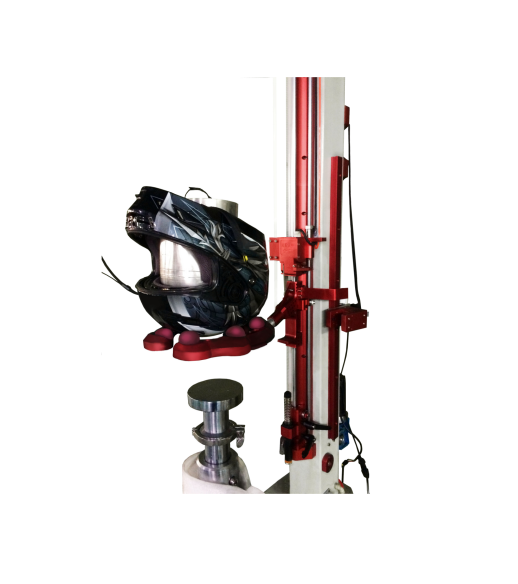
ECE R22.06 is the latest and most stringent European safety standard for motorcycle and two-wheeler helmets. Reliable helmet test equipment is essential for manufacturers, labs, and certification bodies to verify compliance. HOTOTECH provides the ECE R22.06 helmet testing systems covering impact absorption, penetration resistance, retention system performance, and environmental conditioning.
ECE R22.06 Helmet Test Equipment: Principles & Standards