
ECE 22.06 Explained: The Critical Role of Oblique Impact Testing
author: Heather Hu
2025-11-04
ECE 22.06 Explained: The Critical Role of Oblique Impact Testing

For motorcycle riders, a helmet is far more than gear—it’s a life-saving barrier between survival and catastrophic injury. As our understanding of crash dynamics evolves, so too must the standards that ensure helmet effectiveness. Enter ECE 22.06, the latest regulation from the United Nations Economic Commission for Europe (ECE) that redefines motorcycle helmet safety. At the heart of this upgrade lies a game-changing focus: oblique impact testing. This blog breaks down what ECE 22.06 entails, why oblique impacts matter, and how this standard transforms rider protection.
What is ECE 22.06? A Leap Forward in Helmet Safety
Before diving into oblique impact testing, it’s critical to contextualize ECE 22.06 within the landscape of safety regulations.
The Standard’s Core Purpose
ECE 22.06 is a globally recognized regulation that sets rigorous performance requirements for motorcycle helmets, replacing the two-decade-old ECE 22.05 standard . Administered by the ECE, its reach extends beyond Europe to include countries like Canada and the United States, making it one of the most influential safety benchmarks worldwide .
Unlike self-declared certifications (such as the U.S. DOT standard), ECE 22.06 requires helmets to be tested and approved by independent, certified laboratories—eliminating loopholes and ensuring accountability . Its overarching goal? To mirror real-world crash scenarios more accurately and reduce the risk of traumatic brain injuries (TBIs) for riders.
Key Improvements Over ECE 22.05
ECE 22.05 served riders well for 20 years, but advancements in crash research exposed critical gaps. ECE 22.06 addresses these with transformative updates :
- More impact points: Testing expanded from 6 to 18 critical zones, covering the helmet’s entire surface.
- Wider velocity range: Includes low-speed (6 m/s), mid-speed (7.5 m/s), and high-speed (8.2 m/s) impacts.
- Accessory integration: Mandates testing with official add-ons like sun visors and intercom systems.
- Rigidity requirements: Limits post-impact deformation to 50 mm for damaged helmets (vs. 15 mm for undamaged ones).
- Rotational protection: The revolutionary addition of oblique impact testing—our focus here.
Oblique Impact Testing: Why Rotational Forces Are a Game-Changer
For decades, helmet standards focused primarily on linear impacts—direct, head-on collisions that transfer force straight into the skull. But real-world crashes rarely follow this pattern.
h3: The Science of Rotational Brain Injury
Oblique impacts occur when the helmet strikes a surface at an angle, creating rotational motion (a combination of angular velocity and acceleration) . This twisting force doesn’t just move the head—it stretches and shears brain tissue, a mechanism linked to some of the most severe TBIs:
- Diffuse Axonal Injury (DAI): Damage to the brain’s connecting fibers, often resulting in long-term impairment.
- Subdural Hematoma: Bleeding between the brain and its outer membrane.
- Concussions: Mild TBIs that can have lasting cognitive effects .
Research confirms the brain is far more sensitive to rotational forces than linear ones. Even low-speed angled impacts can cause significant injury, while traditional linear testing fails to measure this risk .
How ECE 22.06 Tests for Oblique Impacts
ECE 22.06’s oblique impact protocol is engineered to simulate the angled collisions riders face daily. Here’s how it works :
- Test setup: A dummy head form equipped with accelerometers (to measure rotational forces) is fitted with the helmet.
- Impact surface: The head form is dropped onto a 45-degree steel anvil covered in P80 abrasive paper—mimicking the rough texture of road surfaces.
- Velocity: The impact occurs at 8 m/s, a speed consistent with common crash scenarios.
- Pass criteria: Helmets must keep two key metrics below threshold:
- Rotational Acceleration (PRA): < 10,400 rad/s²
- Brain Injury Criterion (BRIC): < 0.78
This test is not just an add-on—it’s a mandatory requirement that separates ECE 22.06 helmets from their predecessors.
The Real-World Impact of Oblique Testing on Rider Safety
Oblique impact testing isn’t just a technical checkbox; it directly translates to better protection when riders need it most.
Addressing Common Crash Scenarios
Think about typical motorcycle accidents: sliding into a guardrail, hitting a pothole at an angle, or colliding with a vehicle’s side. These are all oblique impact scenarios ECE 22.05 ignored. By requiring helmets to mitigate rotational forces, ECE 22.06 targets the very crashes that cause 70-80% of TBIs in riders .
For example, a low-speed fall (6 m/s) might not fracture the skull, but the rotational force could still cause a concussion. ECE 22.06 ensures helmets absorb this twisting energy rather than transferring it to the brain .
Driving Innovation in Helmet Design
Oblique impact testing has pushed manufacturers to adopt new technologies to meet the standard. Companies now integrate features like:
- Slip planes: Layers that allow the helmet to rotate slightly relative to the head, reducing rotational force.
- Optimized foam liners: Variable-density EPS (expanded polystyrene) that cushions angled impacts.
- Reinforced shells: Materials engineered to flex and disperse rotational energy .
Brands like Koroyd have even tailored their core structures (adjusting tube size, density, and angle) to outperform ECE 22.06’s minimum requirements .
What ECE 22.06 Means for Riders: Beyond Compliance
For consumers, ECE 22.06 certification is more than a legal requirement—it’s a promise of enhanced safety.
Legal and Practical Benefits
- Global acceptance: Valid in over 50 countries, making it ideal for international riders .
- Insurance protection: Many insurers require certified helmets to approve injury claims; ECE 22.06’s rigor strengthens your case .
- Long-term validity: Existing ECE 22.05 helmets remain legal, but new purchases should prioritize 22.06 for modern protection .
How to Identify an ECE 22.06-Certified Helmet
Look for a label inside the helmet displaying:
- The ECE logo
- The certification number (starting with “E” followed by a country code, e.g., E1 for Germany)
- The text “22.06” (not 22.05) .
This label guarantees the helmet has passed oblique impact testing and all other ECE 22.06 requirements.
Conclusion: Oblique Testing = Smarter Protection s
ECE 22.06 isn’t just an update to an old standard—it’s a paradigm shift in how we protect motorcycle riders. By prioritizing oblique impact testing, it addresses the #1 cause of traumatic brain injuries in crashes: rotational force. For manufacturers, it’s a mandate to innovate; for riders, it’s a choice between outdated protection and a helmet engineered for real-world survival.
When shopping for your next helmet, remember: the ECE 22.06 label isn’t just ink on plastic. It’s proof that your gear has been tested to defend against the very impacts that most often lead to injury. In the world of motorcycle safety, that’s not just progress—it’s life-saving.
ECE 22.05 vs 22.06: The Evolution of Motorcycle Helmet Safety Standards
Ensuring Helmet Compliance: The Role of EN960 Headform
Related Article
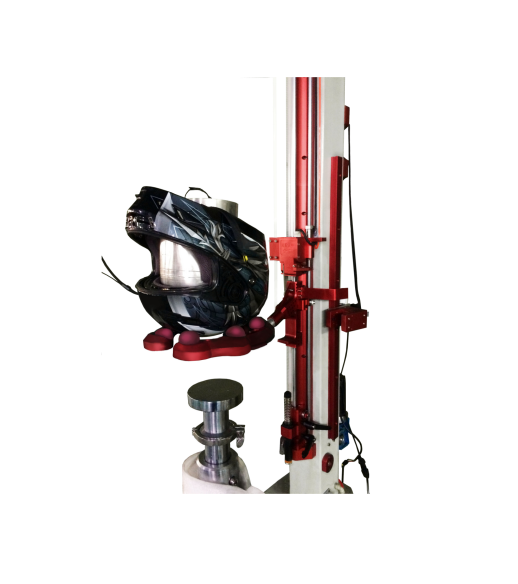
The EN 1078 helmet impact test is an important safety test for bicycle helmets, skateboard helmets and roller skate helmets. The standard EN 1078:2012+A1:2012 specifies requirements and test methods for helmet construction, shock absorption, retention systems, field of vision and marking.
EN 1078 Helmet Impact Test: Bicycle Helmet Shock Absorption Testing

Bicycle helmet compliance testing is essential for verifying helmet safety and impact protection. Learn how EN 1078, CPSC 16 CFR Part 1203, and ASTM F1447 evaluate bicycle helmet performance and why a reliable Bicycle Helmet Impact Tester is important for compliance testing.
Why Bicycle Helmet Compliance Testing Is Important

Every time a cyclist or skater puts on a helmet, they are trusting a lightweight shell to save their life. In the global market, especially in Europe, the EN 1078 standard is the definitive legal benchmark for bicycle helmets, skateboards, and roller skate headgear. Here is an inside look at how this advanced testing equipment puts helmets through their paces to meet EN 1078 certification.
Behind the Safety Shield: How a Helmet Impact Tester Ensures EN 1078 Compliance

ECE R22.06 is the latest and most stringent European safety standard for motorcycle and two-wheeler helmets. Reliable helmet test equipment is essential for manufacturers, labs, and certification bodies to verify compliance. HOTOTECH provides the ECE R22.06 helmet testing systems covering impact absorption, penetration resistance, retention system performance, and environmental conditioning.
ECE R22.06 Helmet Test Equipment: Principles & Standards