
How Does a Helmet Impact Test Machine Work? The Science Behind Simulating Collisions
author: Heather
2025-05-14

How Does a Helmet Impact Test Machine Work? The Science Behind Simulating Collisions

Introduction: The Critical Role of Helmet Safety
Helmets are vital protective gear in various industries, from motorcycle riding to construction and sports. Their ability to absorb and distribute impact forces directly determines their effectiveness in preventing brain injuries. Helmet impact test machines play a pivotal role in ensuring this safety by scientifically simulating real-world collisions. This blog explores how these machines work and the engineering principles behind them.
What is a Helmet Impact Test Machine?
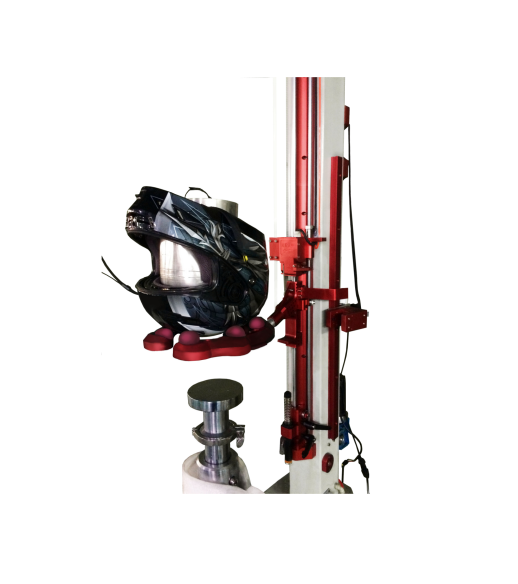
A helmet impact test machine is a specialized device designed to evaluate a helmet’s performance under controlled impact conditions. Its primary goal is to replicate the forces and dynamics of real-life accidents, such as falls or collisions, to measure the helmet’s ability to protect the wearer’s head. These machines are essential for manufacturers to meet safety standards like ASTM, CE, or CPSC.
Key Components of a Helmet Impact Test Machine
- Impact MechanismThe core of the machine is the mechanism that generates impacts. This typically includes a drop tower or pendulum arm to accelerate a weighted impactor (often a metal or composite mass) to a specified velocity. The impactor mimics the shape of a human head, such as a spherical or elliptical form, to simulate realistic contact.
- Data Acquisition SystemSensors and accelerometers are embedded in the impactor or test fixture to measure acceleration forces, deceleration rates, and impact duration. These data points are crucial for analyzing how the helmet absorbs energy and transfers forces to the headform.
- Headform SimulatorA headform—a rigid or anthropometrically shaped model—represents the human head. It is instrumented with sensors to record the acceleration experienced during the impact, which helps calculate the Head Injury Criterion (HIC), a key metric for assessing brain trauma risk.
- Control and Analysis SoftwareAdvanced software controls the test parameters (e.g., impact speed, angle) and processes the collected data. It generates detailed reports to help engineers optimize helmet designs for better impact resistance.
The Science of Simulating Collisions
1. Kinematics and Energy Transfer
Helmet impact testing relies on the principles of kinematics and energy conservation. When the impactor strikes the helmet, kinetic energy from the moving mass is transferred to the helmet and headform. The helmet’s shell, padding, and structural layers are designed to:
- Absorb energy through deformation (e.g., crushable foam liners).
- Distribute forces over a larger area to reduce peak pressure on the head.
- Decelerate the headform gradually to minimize acceleration forces.
2. Impact Velocity and Angle Variability
Test machines can simulate different impact scenarios by adjusting:
- Velocity: Impacts can range from low-speed falls (e.g., 3 m/s for cycling helmets) to high-speed collisions (e.g., 7 m/s for motorcycle helmets).
- Angle: Oblique impacts (e.g., 15° or 45° angles) test the helmet’s performance in non-vertical strikes, which are common in real accidents.
3. Statistical Significance and Repeatability
To ensure reliability, tests are repeated multiple times under identical conditions. This helps validate the helmet’s consistency in performance and account for manufacturing variations.
Applications and Standards Compliance
Helmet impact test machines are used across industries:
- Motorcycle Helmets: Tested for high-velocity impacts and penetration resistance.
- Sports Helmets (e.g., Football, Hockey): Focus on repeated low-to-moderate impacts and rotational force mitigation.
- Industrial Helmets: Evaluated for falling object protection and structural integrity.
Compliance with international standards is non-negotiable. For example:
- ASTM F1492 (USA) specifies impact tests for bike helmets.
- EN 1077 (Europe) outlines procedures for ski helmet testing.
- ISO 3873 sets global standards for industrial safety helmets.
Innovations in Helmet Testing Technology
Modern test machines are integrating advanced technologies to enhance accuracy:
- High-Speed Cameras: Capture microsecond-level deformation of helmets during impacts.
- Wireless Sensor Networks: Enable real-time data transmission and reduce cabling clutter.
- AI and Machine Learning: Analyze large datasets to predict helmet performance in untested scenarios.
Conclusion: Ensuring Safety Through Science
Helmet impact test machines are the unsung heroes of head protection, translating scientific principles into actionable safety standards. By precisely simulating collisions and measuring critical parameters, these machines ensure that every helmet leaving the factory meets the highest safety benchmarks. As technology evolves, so too will the sophistication of these tests, driving innovations that save lives.
Whether you’re a manufacturer, engineer, or consumer, understanding the science behind helmet testing underscores the importance of choosing certified gear. After all, the goal is simple: turning impact forces into data, and data into protection.
Why Climate Chambers Matter in Helmet Testing: Effects of Temperature & Humidity
Motorcycle vs. Construction Helmets: How Testing Standards Differ Across Industries
Related Article
The EN 1078 helmet impact test is an important safety test for bicycle helmets, skateboard helmets and roller skate helmets. The standard EN 1078:2012+A1:2012 specifies requirements and test methods for helmet construction, shock absorption, retention systems, field of vision and marking.
EN 1078 Helmet Impact Test: Bicycle Helmet Shock Absorption Testing

Bicycle helmet compliance testing is essential for verifying helmet safety and impact protection. Learn how EN 1078, CPSC 16 CFR Part 1203, and ASTM F1447 evaluate bicycle helmet performance and why a reliable Bicycle Helmet Impact Tester is important for compliance testing.
Why Bicycle Helmet Compliance Testing Is Important

Every time a cyclist or skater puts on a helmet, they are trusting a lightweight shell to save their life. In the global market, especially in Europe, the EN 1078 standard is the definitive legal benchmark for bicycle helmets, skateboards, and roller skate headgear. Here is an inside look at how this advanced testing equipment puts helmets through their paces to meet EN 1078 certification.
Behind the Safety Shield: How a Helmet Impact Tester Ensures EN 1078 Compliance

ECE R22.06 is the latest and most stringent European safety standard for motorcycle and two-wheeler helmets. Reliable helmet test equipment is essential for manufacturers, labs, and certification bodies to verify compliance. HOTOTECH provides the ECE R22.06 helmet testing systems covering impact absorption, penetration resistance, retention system performance, and environmental conditioning.
ECE R22.06 Helmet Test Equipment: Principles & Standards