Understanding EN 397: The Shield of Industrial Safety and How to Ensure Compliance

Understanding EN 397: The Shield of Industrial Safety and How to Ensure Compliance
In heavy industries like construction, manufacturing, and mining, the industrial safety helmet is the first and last line of defense against head injuries. However, not all helmets are created equal. In the European market and globally, the gold standard for head protection is EN 397.
For safety helmet manufacturers and quality inspection laboratories, compliance with EN 397 is not just a regulatory requirement—it is a commitment to saving lives. But what exactly does this standard demand, and how can manufacturers guarantee their products pass the test?

What is the EN 397 Standard?
EN 397 is the European standard that specifies the physical and performance requirements (including testing methods) for industrial safety helmets. Its primary objective is to protect the wearer against falling objects and the resulting consequences, such as brain injuries or skull fractures.
To meet this standard, a safety helmet must pass a series of rigorous mandatory tests:
-
Shock Absorption (Impact Resistance): The helmet must be able to absorb the force of a falling object to minimize the impact transmitted to the wearer’s head.
-
Penetration Resistance: The helmet shell must prevent sharp or pointed objects from penetrating and making contact with the skull.
-
Flame Resistance: The helmet material must not burn with a flame after the ignition source is removed.
-
Chinstrap Anchor Point Strength: The chinstrap must release or fail at a specific force (between 150 N and 250 N) to prevent the risk of strangulation.
The Critical Test: Shock Absorption and Penetration
Among all the requirements, Shock Absorption is the most critical. During the standard EN 397 test, a 5.0 kg rounded striker is dropped onto the helmet from a height of 1.0 meter. The maximum transmitted force to the headform must not exceed 5.0 kN (Kilonewtons).
For the Penetration Test, a 3.0 kg pointed cone striker is dropped from 1.0 meter, and it must not make electrical or physical contact with the surface of the headform underneath the helmet.
Achieving these precise metrics consistently requires top-tier materials, flawless design, and, most importantly, accurate and reliable testing equipment during the R&D and QA phases.
Meeting the Standard: The Role of the Safety Helmet Impact Testing Machine
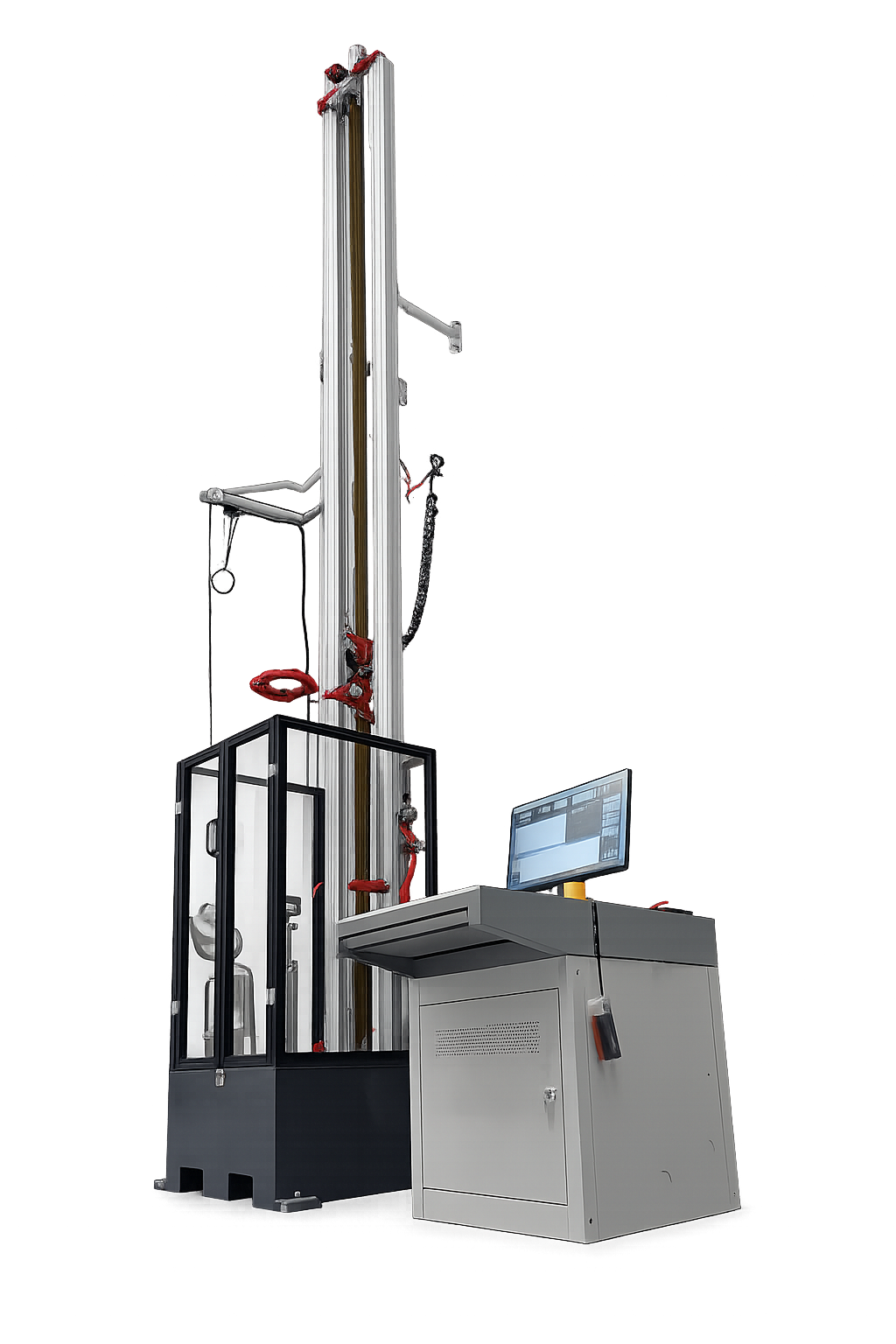
You cannot manage what you do not measure. To confidently launch safety helmets into the international market, manufacturers must replicate EN 397 laboratory conditions in their own facilities. This is where a high-precision Safety Helmet Impact and Penetration Testing Machine becomes indispensable.
Investing in an advanced, automated testing machine offers significant advantages:
1. High-Precision Load Cells and Sensors
The difference between 4.9 kN (Pass) and 5.1 kN (Fail) is a matter of life and death. Premium testing machines are equipped with high-frequency response piezoelectric load cells that capture the exact impact force at the millisecond level, ensuring data integrity.
2. Dual-Purpose Efficiency
Modern testing rigs combine both shock absorption and penetration resistance tests into a single framework. By simply swapping the striker (the rounded weight for impact or the pointed cone for penetration), labs can optimize space and accelerate the testing workflow.
3. Compliance with Multi-Standards
While your current focus might be EN 397, international growth often requires compliance with other regional standards, such as ANSI Z89.1 (USA) or GB/T 2812 (China). A versatile testing machine features adjustable drop heights and customizable headforms to switch between different international testing protocols seamlessly.
Why Pre-Testing Matters for B2B Exporters
For helmet exporters and foreign trade companies, relying solely on third-party certification agencies for final batch testing is a risky strategy.
-
Reduce Product Recall Risks: Catching a structural or material defect early in production saves thousands of dollars in recalled shipments.
-
Accelerate R&D Cycles: Internal testing allows your engineering team to iterate designs, test new polymer blends, and optimize helmet suspension systems rapidly.
-
Build Buyer Trust: Demonstrating to international B2B buyers that you possess in-house EN 397 testing capabilities instantly elevates your brand authority and trustworthiness.
Elevate Your Quality Assurance with HOTOTECH
At HOTOTECH, we specialize in manufacturing high-performance personal protective equipment (PPE) testing machinery. Our Safety Helmet Impact and Penetration Testing Machine is fully engineered to meet and exceed the stringent requirements of EN 397, ANSI Z89.1, and other global standards.
Featuring an automated drop mechanism, real-time data analysis software, and robust safety enclosures, our equipment ensures your production line remains compliant, efficient, and world-class.
Navigating ECE R22.06: Crucial Motorcycle Helmets Test Equipment for Global Compliance
ECE R22.06 Certified: How Modern Test Equipment Validates Maximum Safety for Motorcycle Helmets