EN 12492:2025 – Why Your Next Helmet Impact Tester Must Handle Front, Rear & Side Strikes
EN 12492:2025 – Why Your Next Helmet Impact Tester Must Handle Front, Rear & Side Strikes

Crown-Only Protection Is No Longer Enough
You have designed a climbing helmet that passes crown impact with margin to spare. Your retention system is solid. Your field of vision meets the standard. But here is the problem: EN 12492:2012 is being replaced.
As of April 30, 2026, all mountaineering helmets sold in Europe must comply with EN 12492:2025. And the single biggest change? Multi-directional impact testing.
Crown-only testing is no longer sufficient. The new standard requires your helmet to withstand impacts from the front, rear, and sides — not just the top. If your existing helmet test equipment only performs vertical drops, it is no longer adequate for certification.
If you manufacture climbing, caving, canyoning, or via ferrata helmets, you need a helmet impact tester that can handle all four impact zones.
What Changed in EN 12492:2025?
The 2025 edition introduces several critical updates. Here are the three that matter most to helmet manufacturers.
Multi-Directional Impact – The Game Changer
Under EN 12492:2012, impact testing focused primarily on the crown (top) of the helmet. The 2025 version now requires impact absorption testing at four distinct locations:
-
Crown – 98 J
-
Front – 24.5 J
-
Rear – 24.5 J
-
Lateral (side) – 24.5 J
Why? Real climbing accidents frequently involve oblique and side impacts. A backward fall onto a rock ledge hits the rear. A swing into a wall hits the side. Crown-only protection ignores these common scenarios.
Velocity-Based Control – Not Drop Height
EN 12492:2025 now specifies impact velocity rather than drop height. This improves test precision but requires your helmet impact tester to measure velocity directly — not calculate energy from height alone.
Helmet Positioning Index (HPI)
The new standard introduces a standardized Helmet Positioning Index to ensure consistent helmet placement across all labs. Your impact tester must accommodate HPI-compliant headforms and fixtures.
Why Your Current Setup May Not Be Enough
Here is a hard truth: many existing impact testers cannot perform front, rear, or lateral strikes.
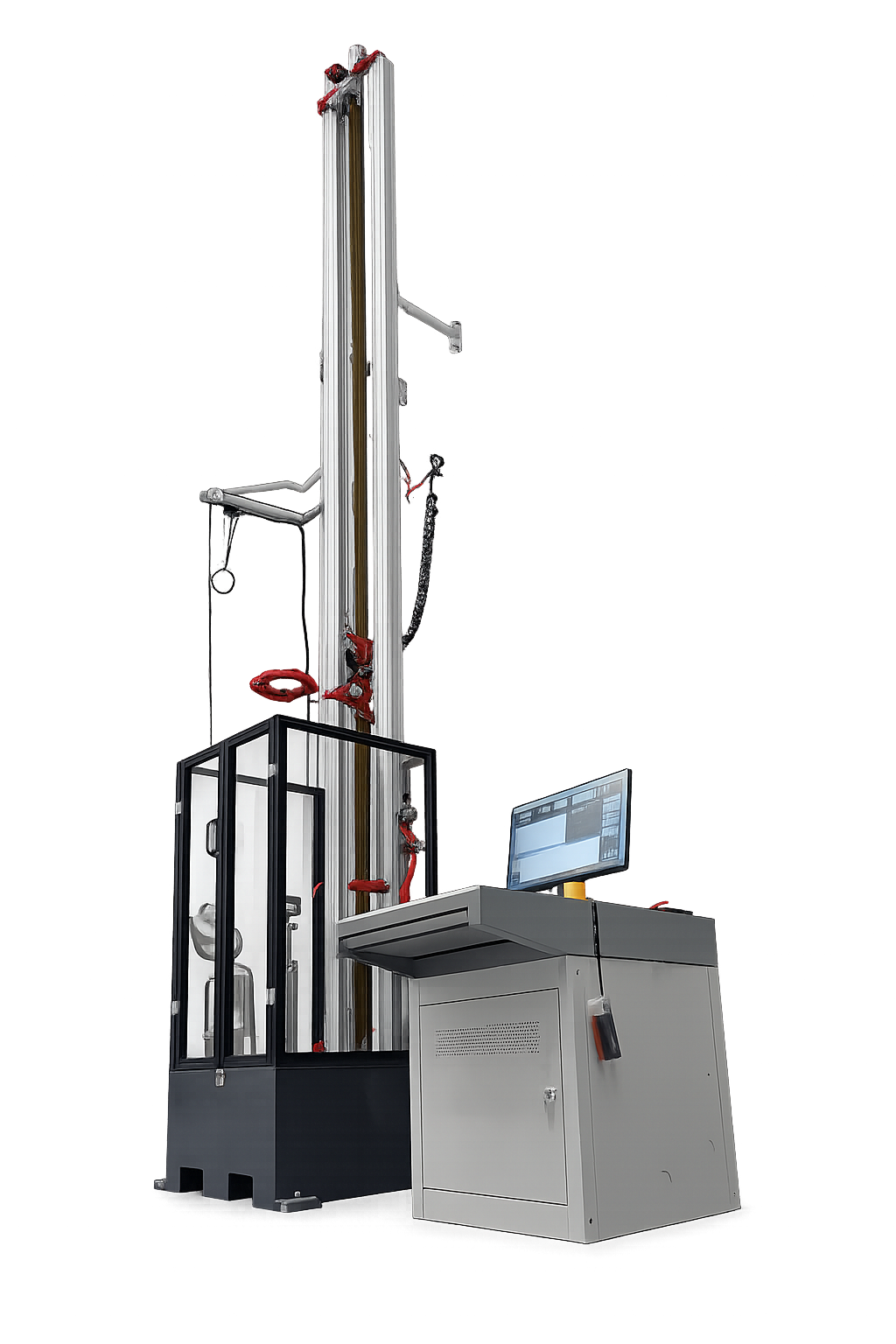
A traditional vertical drop tower is designed for one thing — dropping a striker straight down onto the crown. It cannot rotate to hit the side of a helmet. It cannot tilt to strike the front or rear at the required angle.
To comply with EN 12492:2025, your helmet impact tester must include:
-
A guided impactor that can strike from multiple directions
-
Velocity measurement sensors (light gates or laser)
-
HPI-compliant headforms (magnesium or aluminum, sizes M and L)
-
A force transducer (minimum 20 kN range, Class 1 accuracy)
-
Adjustable headform mounts for precise positioning
Key Features of a Compliant Helmet Impact Tester
If you are shopping for a new helmet impact tester — or upgrading your existing helmet test equipment — here is what to prioritize.
360° Impact Capability
The tester must deliver strikes to crown, front, rear, and lateral positions without complete reconfiguration. Look for a system with a rotatable guided rail or multiple impact positions.
Integrated Velocity Measurement
Do not accept a system that only calculates energy from drop height. The tester must include light gates or laser sensors that measure impact velocity in real time.
HPI-Compatible Headform Mounting
The headform mount must allow precise adjustment to match the Helmet Positioning Index. Ask the supplier for HPI validation documentation.
High-Speed Data Acquisition
Impact forces must be recorded at ≥10 kHz sampling rate to capture peak force accurately. The system should output raw force-time data, not just a pass/fail result.
Interchangeable Anvils
The standard requires flat, line, and wedge anvils. Your impact tester should support quick anvil changes without tools.
EN 12492:2025 Impact Requirements at a Glance
| Impact Location | Energy | Force Limit |
|---|---|---|
| Crown | 98 J | ≤10 kN |
| Front | 24.5 J | ≤10 kN |
| Rear | 24.5 J | ≤10 kN |
| Lateral (side) | 24.5 J | ≤10 kN |
Note: EN 12492:2025 specifies velocity, not drop height. Exact velocity depends on striker mass.
Your Action Plan – Four Steps to Compliance
Step 1 – Assess Your Current Capability
Can your existing impact tester perform front, rear, and lateral impacts? If not, you have a critical gap.
Step 2 – Decide: In-House or Outsource?
-
In-house testing gives you faster design iterations and lower long-term costs. Invest in a multi-directional helmet impact tester.
-
Outsourcing avoids capital expense but creates scheduling risk as labs fill up before April 2026.
Step 3 – Request Supplier Validation
Ask impact tester suppliers for:
-
EN 12492:2025 compliance documentation
-
HPI positioning validation data
-
Velocity measurement accuracy specs (±0.5% typical)
Step 4 – Run a Pre-Compliance Test
Test your current helmet design against the new requirements. Side impacts often reveal weak spots that crown testing misses entirely.
Important Dates
| Date | Event |
|---|---|
| October 15, 2025 | EN 12492:2025 published |
| April 30, 2026 | Mandatory enforcement – old standard withdrawn |
| Until April 30, 2026 | Both versions accepted for new certifications |
Existing EN 12492:2012 certificates remain valid until expiry. But new helmet models after April 30, 2026 must use the 2025 edition.
The Cost of Doing Nothing
If you ignore EN 12492:2025:
-
After April 30, 2026, you cannot certify new mountaineering helmets for Europe
-
Existing certificates will eventually expire
-
Your competitors who upgraded will take your market share
A helmet impact tester that meets the new standard is not an expense — it is an investment in market access.
Conclusion – Multi-Directional Testing Is Non-Negotiable
EN 12492:2025 raises the bar for climbing helmet safety. Real-world accidents involve side and oblique impacts, and the new standard finally recognizes that.
For helmet manufacturers, the path is clear: crown-only testing is dead. You need a helmet impact tester capable of front, rear, and lateral strikes with velocity-based control and HPI-compliant positioning.
Ready to upgrade your helmet test equipment for EN 12492:2025? Contact our team. We supply multi-directional helmet impact testers validated against the new standard — including guided drop towers with 360° impact capability, integrated velocity measurement, and HPI-compliant fixtures.
ECE R22.06 Certified: How Modern Test Equipment Validates Maximum Safety for Motorcycle Helmets
EN 397:2025 – Why Your Impact Absorption Tester Must Be Upgraded Now