EN 397:2025 – Why Your Impact Absorption Tester Must Be Upgraded Now

EN 397:2025 – Why Your Impact Absorption Tester Must Be Upgraded Now
The Single Most Critical Change in EN 397:2025
If you manufacture industrial helmets or operate a test lab, you already know: the 2025 edition of EN 397 is the first major update in nearly 30 years. But among all the changes — chin strap, flame, electrical insulation — one test matters most.
Impact absorption.
Why? Because a helmet that fails impact absorption offers no real protection. And under the new standard, impact absorption testing has fundamentally changed.
From Crown-Only to All-Round Impact Protection
Under the old EN 397:2012, you only needed to test crown impact at 98 J using a vertical drop tower. That was sufficient for Type 1 helmets.
Now, EN 397:2025 introduces Type 2 helmets — which require full all-round impact protection:
-
Crown: 98 J (same as before)
-
Front, rear, and lateral (side) : 24.5 J each
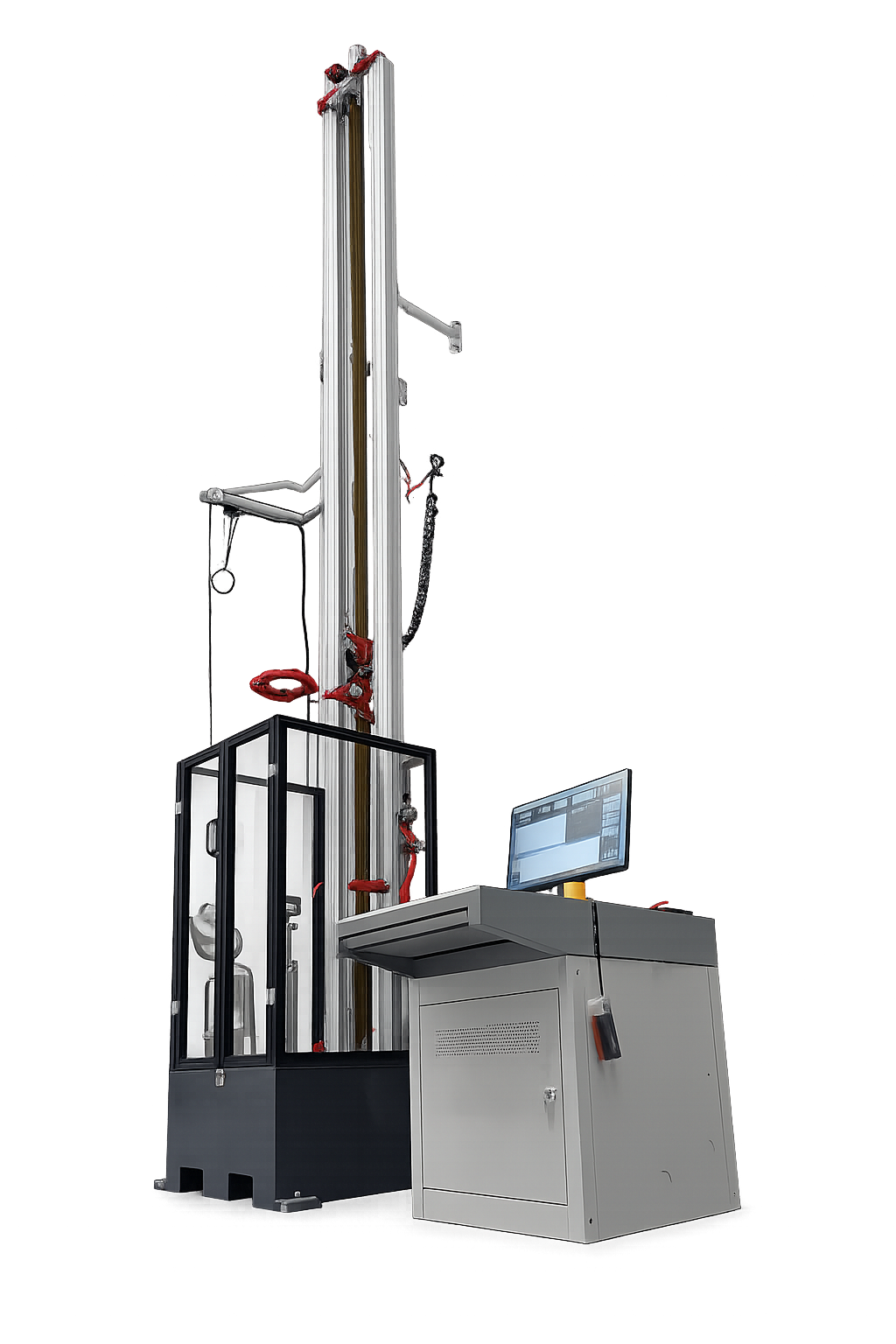
This means your existing impact absorption tester — if it only performs vertical drops — is no longer sufficient for Type 2 certification.
Lateral Impact Is the Real Game Changer
The old lateral deformation test (static compression) has been removed. In its place: a dynamic lateral impact test at 24.5 J.
The test passes only if the transmitted force to the headform does not exceed 10 kN.
What this means for your lab: You cannot simply keep using your old vertical drop tower. You now need an impact absorption tester capable of delivering controlled side strikes while accurately measuring peak force.
What Your New Impact Absorption Tester Must Do
A compliant helmet test equipment setup for EN 397:2025 — specifically for impact absorption — must include the following capabilities.
Vertical Impact (Type 1 and Type 2 Crown)
-
Drop height: 1000 mm (equivalent to 98 J)
-
Anvil types: Flat, line, and wedge (as required by the standard)
-
Headform: Magnesium or aluminum, sizes M and L
-
Force measurement: ≤10 kN peak, class 1 accuracy
Most existing vertical drop towers already support this. The challenge is lateral impact.
Lateral Impact (Type 2 Only – Front, Rear, Side)
-
Impact energy: 24.5 J
-
Impact direction: Horizontal (side strike), plus front and rear
-
Striker configuration: Guided impactor with interchangeable impactor faces
-
Force measurement: Same 10 kN limit, recorded at ≥10 kHz sampling rate
Key requirement: The lateral impact tester must allow precise positioning of the helmet relative to the striker. A simple pendulum is generally not acceptable — the new standard prefers a guided, falling mass system that can be reoriented from vertical to horizontal.
One Tester, Two Orientations – The Smart Upgrade Path
You do not necessarily need two separate machines. The most cost-effective solution is a modular impact absorption tester that can switch between:
-
Vertical mode – for 98 J crown impact (Type 1 and Type 2)
-
Horizontal (lateral) mode – for 24.5 J front, rear, and side impacts (Type 2 only)
Such a system shares the same:
-
Guided drop mechanism
-
Force transducer (20 kN range recommended)
-
Data acquisition unit
-
Interchangeable headforms and anvils
This approach saves laboratory space and capital budget while ensuring full EN 397:2025 compliance.
Don’t Wait Until 2026 – Labs Need to Act Now
Important transition dates:
-
2025 – EN 397:2025 published (available now)
-
2026 – Coexistence period ends. New certifications must follow the 2025 edition.
Existing EN 397:2012 certificates remain valid until expiry. However, if you run a commercial test lab, your customers will start requesting Type 2 testing before 2026. Delaying your impact absorption tester upgrade means losing business.
If you are a helmet manufacturer launching a new Type 2 product in 2025 or 2026, you cannot certify it without lateral impact data.
Quick Checklist – Is Your Current Tester Ready?
| Requirement | Old EN 397:2012 | New EN 397:2025 (Type 2) |
|---|---|---|
| Crown impact (98 J) | ✅ Required | ✅ Required |
| Lateral deformation | ✅ Required (static) | ❌ Removed |
| Lateral impact (24.5 J) | ❌ Not required | ✅ New & mandatory |
| Front/rear impact (24.5 J) | ❌ Not required | ✅ New & mandatory |
| Force limit | 10 kN | 10 kN (same) |
If your helmet test equipment cannot perform lateral impacts, you have a critical compliance gap.
Next Steps for Your Lab
Step 1 – Verify Your Current Capability
Check whether your existing impact absorption tester can be reconfigured for horizontal strikes. Many older systems cannot.
Step 2 – Request a Lateral Impact Retrofit or New Unit
Contact specialized suppliers. Provide:
-
Your current vertical drop tower model (if any)
-
Whether you need full Type 2 capability (front, rear, and side)
-
Your expected test volume
Step 3 – Plan for Calibration and Training
New lateral impact tests require:
-
Recalibration of force transducers for horizontal orientation
-
Operator training on helmet positioning for side strikes
Conclusion – Make Impact Absorption Your First Upgrade
Among all EN 397:2025 changes, impact absorption is the highest priority. A helmet that fails impact absorption fails the entire certification. And without lateral impact capability, you cannot certify Type 2 helmets at all.
Focus your investment on a flexible impact absorption tester that handles both vertical (98 J) and lateral (24.5 J) strikes. Everything else — chin strap, flame, electrical — can follow later.
Need a lateral impact upgrade for your existing drop tower? Contact us. We offer retrofit kits and fully compliant EN 397:2025 impact absorption testers ready for Type 2 certification testing.
EN 12492:2025 – Why Your Next Helmet Impact Tester Must Handle Front, Rear & Side Strikes