
Mattress Roller Tester: How to Evaluate Mattress Durability and Performance
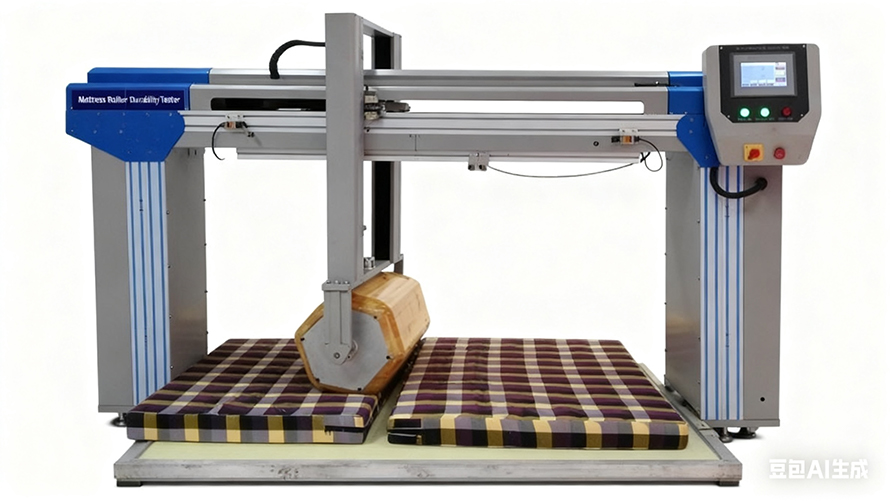
Mattress Roller Tester: How to Evaluate Mattress Durability and Performance

Mattress durability testing is commonly associated with standards such as ASTM F1566 and EN 1957, depending on the target market and product requirements. ASTM F1566 includes test methods for mattress durability, firmness retention, impact and height change.
What Is a Mattress Roller Tester?
A Mattress Roller Tester, also known as a Mattress Durability Tester or Mattress Rolling Test Machine, uses a weighted roller to repeatedly move across the mattress surface.
The repeated rolling action simulates long-term loading and movement that a mattress may experience during normal use.
During the test, the machine can monitor the mattress condition and evaluate changes such as:
- Mattress surface deformation
- Height or thickness loss
- Firmness changes
- Structural damage
- Loss of support
- Long-term rolling fatigue performance
This makes the mattress roller testing machine an important piece of equipment for mattress manufacturers, quality control laboratories, research institutions and third-party testing laboratories.
Why Is Mattress Durability Testing Important?
Mattresses are subjected to repeated compression and movement throughout their service life. A mattress that performs well when new may gradually experience deformation, loss of firmness or structural damage after repeated loading.
A Mattress Durability Test provides a controlled and repeatable way to evaluate this performance.
Durability testing can help manufacturers:
- Compare different mattress constructions.
- Evaluate foam, spring and composite mattress designs.
- Identify potential structural problems.
- Improve mattress materials and manufacturing processes.
- Verify product consistency between production batches.
- Provide objective test data for customers and certification laboratories.
ASTM F1566 states that mattress testing can include durability, firmness, firmness retention, impact and height-change measurements.
ASTM F1566 Mattress Durability Testing
ASTM F1566 is one of the important standards used for evaluating mattresses, mattress sets, innersprings and boxsprings.
The current ASTM listing identifies ASTM F1566-14(2021) and covers recognized test methods for mattress and mattress-set evaluation.
For durability testing, an ASTM-type mattress roller system uses a weighted roller to apply repeated mechanical loading to the mattress.
A typical ASTM F1566 configuration uses a hexagonal roller with a total mass of approximately 109 kg (240 lb). The exact test configuration should always be confirmed against the applicable edition of the standard and the customer's testing requirements.
EN 1957 Mattress Testing
EN 1957 is another important standard used for mattress testing in European markets.
Depending on the test configuration, an EN 1957 mattress testing machine can be used for rolling durability, firmness and height-related measurements.
For example, an EN-type roller configuration commonly uses a cylindrical roller. A suitable mattress testing machine can be configured with different rollers and testing modules according to the required standard.
Because ASTM F1566 and EN 1957 use different test configurations, the roller type, mass, movement, test speed and test procedure should be selected according to the required standard.
How Does a Mattress Roller Test Work?
The basic mattress durability test process is relatively simple:
Step 1 – Place the mattress
The mattress specimen is positioned horizontally on the testing platform.
Step 2 – Install the test roller
The appropriate roller is installed according to the applicable testing standard.
Step 3 – Set the test parameters
The operator sets the rolling speed, rolling distance and number of cycles through the control system.
Step 4 – Start the durability test
The roller repeatedly moves across the mattress surface, applying cyclic mechanical loading.
Step 5 – Complete the required cycles
The machine automatically stops when the preset number of cycles is completed.
Step 6 – Evaluate mattress performance
The mattress can then be evaluated for changes in height, firmness, deformation and overall condition.
Mattress Roller Tester Applications
A Mattress Roller Tester can be used for many types of mattress products, including:
- Spring mattresses
- Pocket spring mattresses
- Foam mattresses
- Memory foam mattresses
- Latex mattresses
- Hybrid mattresses
- Mattress sets
- Mattress foundations and related bedding products
The equipment is suitable for mattress manufacturers, bedding companies, quality control departments, R&D laboratories, universities and third-party testing laboratories.
What Can a Mattress Durability Tester Measure?
Depending on the machine configuration, a mattress testing system can combine several tests in one machine.
1. Rolling Durability Test
Repeated rolling is used to evaluate the long-term durability of the mattress.
2. Firmness Test
A loading device applies a controlled force to the mattress and measures the corresponding deformation to evaluate mattress firmness.
3. Height Loss Test
The mattress thickness or height can be measured before and after durability testing to determine permanent height loss.
4. Edge Durability Test
An optional edge durability test can simulate repeated loading on the mattress edge, such as loading caused when a person sits on the edge of a bed.
Mattress Roller Tester vs. Mattress Durability Tester
These terms are often used interchangeably in the testing equipment industry.
Mattress Roller Tester emphasizes the rolling mechanism used to perform the durability test.
Mattress Durability Tester is a broader term that describes equipment designed to evaluate the long-term performance and durability of mattresses.
A modern Mattress Durability Testing Machine can combine rolling fatigue, firmness and height-loss testing in a single system.
How to Choose a Mattress Roller Testing Machine?
Before purchasing a mattress roller tester, manufacturers and laboratories should confirm several important points:
- Applicable testing standard
- Mattress dimensions
- Roller type
- Roller mass
- Rolling distance
- Test speed
- Required number of cycles
- Firmness testing requirements
- Height-loss measurement requirements
- Edge durability requirements
- Control and data recording system
The most important point is to select the machine configuration according to the specific test standard and customer's testing procedure, rather than choosing a machine only by its appearance or general specifications.
Conclusion
A Mattress Roller Tester provides a controlled method for evaluating mattress durability and long-term performance. By simulating repeated rolling and loading, manufacturers can identify changes in mattress firmness, height and structural performance.
For laboratories and manufacturers targeting international markets, standards such as ASTM F1566 and EN 1957 are important references when selecting a mattress durability testing machine.
Choosing the correct Mattress Roller Testing Machine and test configuration can help manufacturers improve product quality, compare different mattress designs and generate reliable durability test data.
Demystifying ASTM F1566: How Does the Global "Language" of Mattress Durability Testing Work?