Demystifying ASTM F1566: How Does the Global "Language" of Mattress Durability Testing Work?
Demystifying ASTM F1566: How Does the Global "Language" of Mattress Durability Testing Work?

Introduction: The Universal Challenge of Mattress Longevity
When you purchase a mattress, you're investing in years of rest and recovery. But how can manufacturers—and consumers—objectively measure whether a mattress will stand the test of time? This is where ASTM F1566 comes into play. Often called the global "language" of mattress durability testing, this standard provides a rigorous, scientific, and universally understood methodology to assess how a mattress will perform over years of use. For manufacturers, retailers, and testing laboratories around the world, ASTM F1566 is the foundational protocol that ensures reliability, supports quality claims, and fosters fair competition. This blog will unpack how this critical standard works and the essential role of specialized mattress testing equipment in bringing it to life.
What is ASTM F1566?
ASTM F1566 is a standardized test method developed by ASTM International (formerly the American Society for Testing and Materials). Specifically titled "Standard Test Methods for Evaluation of Innersprings, Boxsprings, Mattresses, or Sleep Sets," it provides detailed procedures for simulating the long-term wear and tear a mattress endures during its lifetime.
Think of it as a common technical vocabulary. Whether a mattress is made in the United States, Europe, or Asia, if it is tested according to ASTM F1566, the results are understood and comparable globally. This allows for:
-
Objective Quality Benchmarks: Moving beyond subjective "feel" to quantifiable durability data.
-
Reliability for Specifiers: Giving hotels, hospitals, and dormitories confidence in their bulk purchases.
-
Informed Consumer Choice: Supporting durability claims in marketing with standardized proof.
The Core of the Standard: Simulating a Decade of Sleep in Hours
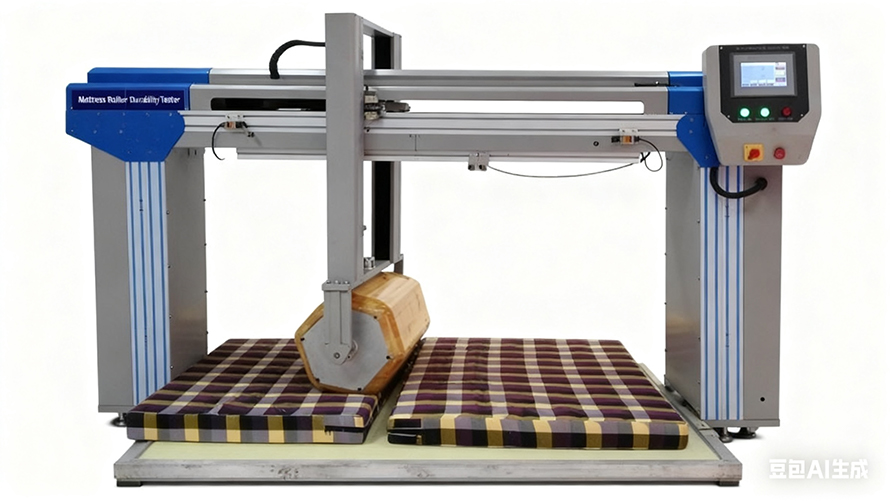
The genius of ASTM F1566 lies in its practical simulation. The primary test involves a rolling, indenting device—often called a drum tester or rollator—that repeatedly passes over the mattress surface. This action replicates the combined forces of a person lying down, turning, and getting in and out of bed over many years.
Key Testing Parameters:
-
Cycles: The test defines a specific number of cycles (e.g., 100,000 cycles may simulate roughly 10-15 years of use). Each pass of the roller counts as one cycle.
-
Load & Indentation: The roller applies a defined force, creating a specific indentation depth to simulate body weight.
-
Test Phases: The standard often includes procedures for testing both before and after a conditioning phase (which simulates initial break-in), providing a complete picture of performance.
The Engine of Validation: Mattress Testing Equipment
You cannot execute ASTM F1566 without precise, robust, and repeatable machinery. This is where dedicated mattress durability testers become indispensable.
Primary Purpose of the Equipment
The core function of this testing equipment is to automate the simulation defined in the standard with unwavering consistency. A human tester could never apply exactly 120 pounds of force, at the exact same speed and point of contact, for tens of thousands of repetitions. The machine eliminates human error and variability, ensuring results are solely a reflection of the product's quality.
Key Capabilities of a Modern Mattress Testing System:
-
Precision Actuation: Uses servo-motors or hydraulic systems to control the roller's force, speed, and path with high accuracy.
-
Programmable Control: Operators can input the exact number of cycles, load, and speed as mandated by the standard or specific internal quality protocols.
-
Data Acquisition: Integrated sensors measure load, deflection (sag), and height loss in real-time. This data is critical for the final pass/fail analysis.
-
Durability & Safety: Built to operate continuously under heavy cyclic loading, with safety guards to protect operators.
Breaking Down the Test: A Step-by-Step Overview
Pre-Test Preparation
The mattress is measured and conditioned. Initial height and firmness measurements are recorded to establish a baseline.
The Main Durability Test
The mattress is placed on the tester's platform. The rolling drum is positioned and the test is initiated. For the next several hours or days (depending on the cycle count), the machine systematically traverses the mattress surface.
Post-Test Evaluation
After the designated cycles are complete, the mattress is re-measured.
-
The Critical Measurement: The standard specifies allowable limits for height loss and sometimes changes in firmness. A common threshold is that the mattress must not lose more than a certain percentage (e.g., 1.5 or 2 inches) of its initial height after testing.
-
Visual Inspection: Testers also check for any structural failures like broken coils, torn seams, or compromised upholstery.
Why This "Language" Matters for the Global Market
For Manufacturers: Quality Control & Innovation
ASTM F1566 provides an objective benchmark for internal quality control. It allows R&D teams to test new materials, coil systems, and designs against a known standard, driving innovation while ensuring durability isn't sacrificed. It's a tool for continuous product improvement.
For Retailers & Specifiers: Risk Mitigation & Confidence
Hotels, universities, and healthcare facilities purchase mattresses in bulk with the expectation they will last. Specifying that products must meet ASTM F1566 requirements mitigates the financial risk of premature failure. It transforms a durability claim from marketing language into a verifiable specification.
For the Industry: Fair Competition & Consumer Trust
When all players test to the same standard, it creates a level playing field. Durability claims are substantiated by comparable data, which helps build overall consumer trust in the industry. It shifts the conversation from price alone to a more nuanced discussion of long-term value.
Beyond the Standard: The Bigger Picture
While ASTM F1566 is the cornerstone, it's often part of a larger testing regimen. Mattresses may also be tested for:
-
Flammability (e.g., ASTM E1590): For critical safety compliance.
-
Firmness & Comfort (IFD/ILD testing): Quantifying the "feel."
-
Edge Support: Testing resistance to sagging at the perimeter.
The mattress testing equipment used for F1566 is frequently part of a larger quality assurance laboratory, serving as the ultimate stress-test that proves a product's structural integrity.
Conclusion: More Than Just a Test, A Commitment to Quality
ASTM F1566 is far more than a technical document. It is the globally recognized language of resilience for the sleep products industry. By translating a decade of nightly use into a rigorous, repeatable laboratory procedure, it empowers every stakeholder—from the factory floor to the showroom floor to the end consumer.
The sophisticated mattress testing machines that execute this standard are the unsung heroes, providing the hard data that separates hope from certainty. In a world of countless choices, this universal language of testing ensures that when a mattress promises durability, it speaks a truth that can be measured, verified, and trusted.
Mattress Roller Tester: How to Evaluate Mattress Durability and Performance